A 1.5 V battery provides 0.50 A of current. How much work does the charge escalator do to lift 1.0 C of charge?
Ch 27: Current and Resistance
Knight Calc5th EditionPhysics for Scientists and EngineersISBN: 9780137344796Not the one you use?Change textbook
Chapter 27, Problem 23
A hollow copper sphere has inner radius 1.0 cm and outer radius 2.5 cm. A 5.0 A current flows radially outward from the inner surface to the outer surface. What is the electric field strength at r=2.0 cm?
Verified step by step guidance1
Step 1: Understand the problem. The electric field strength at a distance r from the center of the hollow sphere can be calculated using the relationship between current density, charge flow, and electric field. The current flows radially outward, and the geometry of the sphere suggests that the electric field depends on the radial distance r.
Step 2: Calculate the current density J. The current density is defined as the current per unit area. For a spherical shell, the area at a radial distance r is given by the surface area of a sphere: \( A = 4 \pi r^2 \). Use \( J = \frac{I}{A} \), where \( I \) is the current and \( A \) is the area.
Step 3: Relate the current density to the electric field. In a conductor, the current density \( J \) is related to the electric field \( E \) by the equation \( J = \sigma E \), where \( \sigma \) is the conductivity of the material. Rearrange this equation to solve for \( E \): \( E = \frac{J}{\sigma} \).
Step 4: Determine the conductivity \( \sigma \) of copper. Look up the conductivity of copper (a known material property) or use the value provided in the problem if specified. Substitute \( \sigma \) and \( J \) into the equation for \( E \).
Step 5: Evaluate \( E \) at \( r = 2.0 \) cm. Substitute \( r = 2.0 \) cm into the expressions for \( A \) and \( J \), and then calculate \( E \) using the formula derived in the previous steps. Ensure all units are consistent (e.g., convert cm to meters).

Verified video answer for a similar problem:
This video solution was recommended by our tutors as helpful for the problem above.
Video duration:
2mWas this helpful?
Key Concepts
Here are the essential concepts you must grasp in order to answer the question correctly.
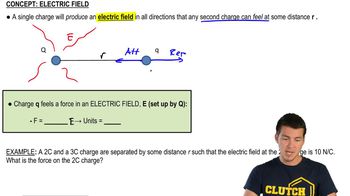
Electric Field
The electric field is a vector field that represents the force exerted by an electric charge on other charges in its vicinity. It is defined as the force per unit charge and is measured in volts per meter (V/m). In this scenario, the electric field strength at a specific radius within the hollow sphere is crucial for understanding how the current affects the surrounding space.
Recommended video:
Guided course
Intro to Electric Fields
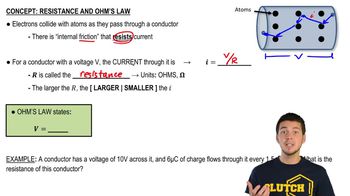
Ohm's Law
Ohm's Law states that the current (I) flowing through a conductor between two points is directly proportional to the voltage (V) across the two points and inversely proportional to the resistance (R) of the conductor. This relationship is expressed as V = IR. In the context of the hollow sphere, understanding how current relates to electric field and resistance is essential for calculating the electric field strength.
Recommended video:
Guided course
Resistance and Ohm's Law
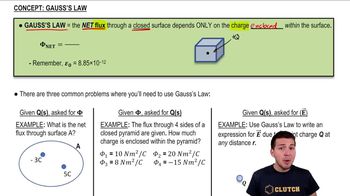
Gauss's Law
Gauss's Law relates the electric flux passing through a closed surface to the charge enclosed by that surface. It is mathematically expressed as Φ_E = Q_enc/ε_0, where Φ_E is the electric flux, Q_enc is the enclosed charge, and ε_0 is the permittivity of free space. This law is particularly useful in this problem to determine the electric field at a point within the hollow sphere by considering the symmetry and the distribution of the current.
Recommended video:
Guided course
Gauss' Law
Related Practice
Textbook Question
1523
views
Textbook Question
What electric field strength is needed to create a 5.0 A current in a 2.0-mm-diameter iron wire?
224
views
Textbook Question
A car battery is rated at 90 A h, meaning that it can supply a 90 A current for 1 h before being completely discharged. If you leave your headlights on until the battery is completely dead, how much charge leaves the battery?
68
views
Textbook Question
A 1.5 V battery provides 0.50 A of current. At what rate (C/s) is charge lifted by the charge escalator?
66
views
Textbook Question
A 0.0075 V/m electric field creates a 3.9 mA current in a 1.0-mm-diameter wire. What material is the wire made of?
73
views
Textbook Question
An engineer cuts a 1.0-m-long, 0.33-mm-diameter piece of wire, connects it across a 1.5 V battery, and finds that the current in the wire is 8.0 A. Of what material is the wire made?
367
views