- 1. Introduction to Accounting40m
- 2. Transaction Analysis1h 13m
- 3. Accrual Accounting Concepts2h 37m
- Accrual Accounting vs. Cash Basis Accounting10m
- Revenue Recognition and Expense Recognition24m
- Introduction to Adjusting Journal Entries and Prepaid Expenses36m
- Adjusting Entries: Supplies12m
- Adjusting Entries: Unearned Revenue11m
- Adjusting Entries: Accrued Expenses12m
- Adjusting Entries: Accrued Revenues6m
- Adjusting Entries: Depreciation15m
- Summary of Adjusting Entries7m
- Unadjusted vs Adjusted Trial Balance6m
- Closing Entries10m
- Post-Closing Trial Balance2m
- 4. Merchandising Operations1h 54m
- Service Company vs. Merchandising Company10m
- Net Sales28m
- Cost of Goods Sold - Perpetual Inventory vs. Periodic Inventory9m
- Perpetual Inventory - Purchases10m
- Perpetual Inventory - Purchase Discounts11m
- Perpetual Inventory - Purchasing Summary6m
- Periodic Inventory - Purchases14m
- Periodic Inventory - Purchase Discounts10m
- Periodic Inventory - Purchasing Summary6m
- Single-step Income Statement4m
- 5. Inventory1h 35m
- Merchandising Company vs. Manufacturing Company6m
- Physical Inventory Count, Ownership of Goods, and Consigned Goods4m
- Specific Identification7m
- Periodic Inventory - FIFO, LIFO, and Average Cost23m
- Perpetual Inventory - FIFO, LIFO, and Average Cost31m
- Financial Statement Effects of Inventory Costing Methods10m
- Lower of Cost or Market11m
- 6. Internal Controls and Reporting Cash1h 16m
- 7. Receivables and Investments3h 16m
- Types of Receivables8m
- Net Accounts Receivable: Direct Write-off Method5m
- Net Accounts Receivable: Allowance for Doubtful Accounts13m
- Net Accounts Receivable: Percentage of Sales Method9m
- Net Accounts Receivable: Aging of Receivables Method11m
- Notes Receivable25m
- Introduction to Investments in Securities13m
- Trading Securities31m
- Available-for-Sale (AFS) Securities26m
- Held-to-Maturity (HTM) Securities17m
- Equity Method33m
- 8. Long Lived Assets4h 36m
- Initial Cost of Long Lived Assets42m
- Basket (Lump-sum) Purchases13m
- Ordinary Repairs vs. Capital Improvements10m
- Depreciation: Straight Line32m
- Depreciation: Declining Balance33m
- Depreciation: Units-of-Activity28m
- Depreciation for Partial Years13m
- Retirement of Plant Assets (No Proceeds)14m
- Sale of Plant Assets18m
- Change in Estimate: Depreciation17m
- Natural Resources and Depletion16m
- Asset Impairments16m
- Exchange for Similar Assets16m
- 9. Current Liabilities2h 12m
- 10. Time Value of Money1h 27m
- 11. Long Term Liabilities2h 45m
- 12. Stockholders' Equity2h 2m
- Characteristics of a Corporation14m
- Issuing Par Value Stock12m
- Issuing No Par Value Stock5m
- Issuing Common Stock for Assets or Services8m
- Retained Earnings14m
- Retained Earnings: Prior Period Adjustments9m
- Preferred Stock11m
- Treasury Stock9m
- Dividends and Dividend Preferences17m
- Stock Dividends10m
- Stock Splits9m
- 13. Statement of Cash Flows2h 10m
- 14. Financial Statement Analysis5h 19m
- Horizontal Analysis14m
- Vertical Analysis21m
- Common-sized Statements5m
- Trend Percentages7m
- Discontinued Operations and Extraordinary Items3m
- Introduction to Ratios8m
- Ratios: Earnings Per Share (EPS)10m
- Ratios: Working Capital and the Current Ratio14m
- Ratios: Quick (Acid Test) Ratio12m
- Ratios: Gross Profit Rate9m
- Ratios: Profit Margin7m
- Ratios: Quality of Earnings Ratio8m
- Ratios: Inventory Turnover10m
- Ratios: Average Days in Inventory9m
- Ratios: Accounts Receivable (AR) Turnover9m
- Ratios: Average Collection Period (Days Sales Outstanding)8m
- Ratios: Return on Assets (ROA)8m
- Ratios: Total Asset Turnover5m
- Ratios: Fixed Asset Turnover5m
- Ratios: Profit Margin x Asset Turnover = Return On Assets9m
- Ratios: Accounts Payable Turnover6m
- Ratios: Days Payable Outstanding (DPO)8m
- Ratios: Times Interest Earned (TIE)7m
- Ratios: Debt to Asset Ratio5m
- Ratios: Debt to Equity Ratio5m
- Ratios: Payout Ratio5m
- Ratios: Dividend Yield Ratio9m
- Ratios: Return on Equity (ROE)10m
- Ratios: DuPont Model for Return on Equity (ROE)20m
- Ratios: Free Cash Flow10m
- Ratios: Price-Earnings Ratio (PE Ratio)7m
- Ratios: Book Value per Share of Common Stock7m
- Ratios: Cash to Monthly Cash Expenses8m
- Ratios: Cash Return on Assets7m
- Ratios: Economic Return from Investing3m
- Ratios: Capital Acquisition Ratio6m
- 15. GAAP vs IFRS42m
- GAAP vs. IFRS: Recording Differences4m
- GAAP vs. IFRS: Adjusting Entries4m
- GAAP vs. IFRS: Merchandising3m
- GAAP vs. IFRS: Inventory3m
- GAAP vs. IFRS: Fraud, Internal Controls, and Cash3m
- GAAP vs. IFRS: Receivables2m
- GAAP vs. IFRS: Long Lived Assets5m
- GAAP vs. IFRS: Liabilities3m
- GAAP vs. IFRS: Stockholders' Equity3m
- GAAP vs. IFRS: Statement of Cash Flows5m
- GAAP vs. IFRS: Analysis and Income Statement Presentation5m
- 16. Introduction to Managerial Accounting1h 36m
- 17. Job Order Costing1h 44m
- 18. Process Costing1h 4m
- 19. Cost Behavior1h 27m
- 20. Cost-Volume-Profit-Analysis1h 25m
- 21. Variable Costing29m
- 22. Activity-Based Costing43m
- 23. The Master Budget3h 56m
- Introduction to Budgeting4m
- Benefits of Budgeting4m
- Types of Budgets7m
- Overview of Master Budgeting11m
- Sales Budget14m
- Production Budget21m
- Direct Materials Budget23m
- Direct Labor Budget8m
- Manufacturing Overhead Budget11m
- Ending Finished Goods Inventory Budget11m
- Operating Expenses Budget9m
- Capital Expenditures Budget7m
- Cash Budget1h 1m
- Budgeted Income Statement9m
- Budgeted Balance Sheet31m
- 24. Flexible Budgets40m
- 25. Standard Costs and Variances36m
- 26. Performance Evaluation & The Balanced Scorecard34m
- 27. Decision Making34m
- 28. Capital Budgeting46m
Capital Expenditures Budget: Videos & Practice Problems
A Capital Expenditures Budget tracks irregular, high-cost purchases that are not included in the regular product cost or operating expenses budget. It focuses on long-term assets and major equipment, such as a kiln, forklift, or other large pieces of equipment the business does not buy every quarter. Because these purchases happen infrequently, the information usually comes directly from management forecasts rather than from the standard budget schedules.
The budget is organized by time period, often by quarter, and shows when each major purchase is expected and the total amount for the year. Its purpose is to identify how much must be set aside for these important asset purchases and to make sure they are not overlooked in planning. This budget also matters for cash disbursements, because the purchase of major equipment creates cash outflows that have not been captured elsewhere, making it an essential input to the cash budget.
Capital Expenditures Budget


Capital Expenditures Budget
A furniture maker has set the following budgeted Unit Sales for the coming three months:
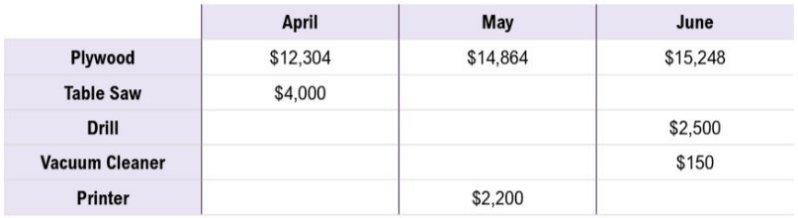
The variable operating expense is \$2.50 per unit with fixed monthly operating expenses of \$1,000 for rent, \$3,500 for staff salaries, and \$1,200 for depreciation. Calculate the operating expense budget for the month of May.
\$14,864
\$0
\$2,200
\$17,064
Here's what students ask on this topic:
A capital expenditures budget is a financial plan that tracks large, irregular purchases of long-term assets, such as equipment or machinery, that a business does not buy regularly. These purchases are not included in the regular product cost or operating expenses budgets. The importance of this budget lies in its ability to help a business plan for significant cash outflows that occur infrequently but have a major impact on the company's financial health. By forecasting when these purchases will happen and how much they will cost, the business can ensure it has enough cash set aside to cover these expenses without disrupting regular operations. This budget also feeds into the cash budget, providing a complete picture of cash inflows and outflows.
To calculate the total annual capital expenditures, you add the amounts planned for each quarter. If , , , and represent the capital expenditures for quarters 1 through 4 respectively, then the annual total is calculated as:
This sum gives the total amount the business plans to spend on capital assets during the year.
A capital expenditures budget includes expenses for large, long-term assets that a business purchases irregularly. Examples include equipment like kilns, forklifts, sewing machines, or other machinery essential for operations. These are not routine operating expenses or product costs but significant investments that support the company's production or service capabilities. Because these purchases happen infrequently, they are tracked separately to ensure proper cash planning and budgeting. The budget helps the company anticipate when these large expenses will occur and how much cash will be needed to cover them.
The capital expenditures budget directly impacts the cash budget because it accounts for large cash outflows that are not included in operating or product cost budgets. Since capital expenditures involve significant purchases that occur irregularly, they represent new cash disbursements that must be planned for. The cash budget incorporates these expenditures to provide a complete view of the company's cash inflows and outflows throughout the year. Without including the capital expenditures budget, the cash budget would underestimate the cash needed, potentially leading to cash shortages during periods of major asset purchases.
The information for the capital expenditures budget typically comes from company personnel responsible for planning and managing long-term assets, such as a manager or department head. In the example of the pottery company, this information was provided by Pam, who forecasted the need to purchase a new kiln in quarter 3. Since capital expenditures are irregular and not part of routine expenses, this budget relies on forecasts and plans from those who understand the timing and cost of major equipment purchases rather than from standard budget documents.