- Ch. 1 Introduction to Accounting1h 9m
- Ch. 2 Transaction Analysis1h 13m
- Ch. 3 Accrual Accounting Concepts2h 37m
- Accrual Accounting vs. Cash Basis Accounting10m
- Revenue Recognition and Expense Recognition24m
- Introduction to Adjusting Journal Entries and Prepaid Expenses36m
- Adjusting Entries: Supplies12m
- Adjusting Entries: Unearned Revenue11m
- Adjusting Entries: Accrued Expenses12m
- Adjusting Entries: Accrued Revenues6m
- Adjusting Entries: Depreciation15m
- Summary of Adjusting Entries7m
- Unadjusted vs Adjusted Trial Balance6m
- Closing Entries10m
- Post-Closing Trial Balance2m
- Ch. 4 Merchandising Operations2h 30m
- Service Company vs. Merchandising Company10m
- Net Sales28m
- Cost of Goods Sold - Perpetual Inventory vs. Periodic Inventory9m
- Perpetual Inventory - Purchases10m
- Perpetual Inventory - Freight Costs9m
- Perpetual Inventory - Purchase Discounts11m
- Perpetual Inventory - Purchasing Summary6m
- Periodic Inventory - Purchases14m
- Periodic Inventory - Freight Costs7m
- Periodic Inventory - Purchase Discounts10m
- Periodic Inventory - Purchasing Summary6m
- Single-step Income Statement4m
- Multi-step Income Statement17m
- Comprehensive Income2m
- Ch. 5 Inventory1h 55m
- Merchandising Company vs. Manufacturing Company6m
- Physical Inventory Count, Ownership of Goods, and Consigned Goods10m
- Specific Identification7m
- Periodic Inventory - FIFO, LIFO, and Average Cost23m
- Perpetual Inventory - FIFO, LIFO, and Average Cost31m
- Financial Statement Effects of Inventory Costing Methods10m
- Lower of Cost or Market11m
- Inventory Errors14m
- Ch.6 Internal Controls and Reporting Cash1h 16m
- Ch. 7 Receivables and Investments3h 8m
- Types of Receivables8m
- Net Accounts Receivable: Direct Write-off Method5m
- Net Accounts Receivable: Allowance for Doubtful Accounts13m
- Net Accounts Receivable: Percentage of Sales Method9m
- Net Accounts Receivable: Aging of Receivables Method11m
- Notes Receivable25m
- Introduction to Investments in Securities13m
- Trading Securities31m
- Available-for-Sale (AFS) Securities26m
- Held-to-Maturity (HTM) Securities17m
- Equity Method25m
- Ch. 8 Long Lived Assets5h 6m
- Initial Cost of Long Lived Assets42m
- Basket (Lump-sum) Purchases13m
- Ordinary Repairs vs. Capital Improvements10m
- Depreciation: Straight Line32m
- Depreciation: Declining Balance33m
- Depreciation: Units-of-Activity28m
- Depreciation: Summary of Main Methods8m
- Depreciation for Partial Years13m
- Retirement of Plant Assets (No Proceeds)14m
- Sale of Plant Assets18m
- Change in Estimate: Depreciation21m
- Intangible Assets and Amortization17m
- Natural Resources and Depletion16m
- Asset Impairments16m
- Exchange for Similar Assets16m
- Ch.9 Current Liabilities2h 19m
- Ch. 10 Time Value of Money1h 27m
- Ch. 11 Long Term Liabilities2h 45m
- Ch. 12 Stockholders' Equity2h 15m
- Characteristics of a Corporation17m
- Shares Authorized, Issued, and Outstanding9m
- Issuing Par Value Stock12m
- Issuing No Par Value Stock5m
- Issuing Common Stock for Assets or Services8m
- Retained Earnings14m
- Retained Earnings: Prior Period Adjustments9m
- Preferred Stock11m
- Treasury Stock9m
- Dividends and Dividend Preferences17m
- Stock Dividends10m
- Stock Splits9m
- Ch. 13 Statement of Cash Flows2h 24m
- Ch. 14 Financial Statement Analysis5h 25m
- Horizontal Analysis14m
- Vertical Analysis21m
- Common-sized Statements5m
- Trend Percentages7m
- Discontinued Operations and Extraordinary Items6m
- Introduction to Ratios8m
- Ratios: Earnings Per Share (EPS)10m
- Ratios: Working Capital and the Current Ratio14m
- Ratios: Quick (Acid Test) Ratio12m
- Ratios: Gross Profit Rate9m
- Ratios: Profit Margin7m
- Ratios: Quality of Earnings Ratio8m
- Ratios: Inventory Turnover10m
- Ratios: Average Days in Inventory9m
- Ratios: Accounts Receivable (AR) Turnover9m
- Ratios: Average Collection Period (Days Sales Outstanding)8m
- Ratios: Return on Assets (ROA)8m
- Ratios: Total Asset Turnover5m
- Ratios: Fixed Asset Turnover5m
- Ratios: Profit Margin x Asset Turnover = Return On Assets9m
- Ratios: Accounts Payable Turnover6m
- Ratios: Days Payable Outstanding (DPO)8m
- Ratios: Times Interest Earned (TIE)7m
- Ratios: Debt to Asset Ratio5m
- Ratios: Debt to Equity Ratio5m
- Ratios: Payout Ratio5m
- Ratios: Dividend Yield Ratio9m
- Ratios: Return on Equity (ROE)10m
- Ratios: DuPont Model for Return on Equity (ROE)20m
- Ratios: Free Cash Flow10m
- Ratios: Price-Earnings Ratio (PE Ratio)7m
- Ratios: Book Value per Share of Common Stock7m
- Ratios: Cash to Monthly Cash Expenses8m
- Ratios: Cash Return on Assets7m
- Ratios: Economic Return from Investing6m
- Ratios: Capital Acquisition Ratio6m
- Ch. 15 GAAP vs IFRS56m
- GAAP vs. IFRS: Introduction7m
- GAAP vs. IFRS: Classified Balance Sheet6m
- GAAP vs. IFRS: Recording Differences4m
- GAAP vs. IFRS: Adjusting Entries4m
- GAAP vs. IFRS: Merchandising3m
- GAAP vs. IFRS: Inventory3m
- GAAP vs. IFRS: Fraud, Internal Controls, and Cash3m
- GAAP vs. IFRS: Receivables2m
- GAAP vs. IFRS: Long Lived Assets5m
- GAAP vs. IFRS: Liabilities3m
- GAAP vs. IFRS: Stockholders' Equity3m
- GAAP vs. IFRS: Statement of Cash Flows5m
- GAAP vs. IFRS: Analysis and Income Statement Presentation5m
- Ch. 16 Introduction to Managerial Accounting1h 36m
- Ch. 17 Job Order Costing38m
- Ch. 18 Process Costing1h 0m
- Ch. 19 Cost Behavior1h 27m
- Ch. 20 Cost-Volume-Profit-Analysis1h 25m
- Ch. 21 Variable Costing29m
- Ch. 22 Activity-Based Costing43m
- Ch. 23 The Master Budget3h 51m
- Introduction to Budgeting4m
- Benefits of Budgeting4m
- Types of Budgets7m
- Overview of Master Budgeting11m
- Sales Budget14m
- Production Budget21m
- Direct Materials Budget23m
- Direct Labor Budget8m
- Manufacturing Overhead Budget11m
- Ending Finished Goods Inventory Budget11m
- Operating Expenses Budget9m
- Capital Expenditures Budget5m
- Cash Budget59m
- Budgeted Income Statement9m
- Budgeted Balance Sheet31m
Unit Product Cost: Videos & Practice Problems
Unit Product Cost focuses on which costs are attached to each unit of product under absorption costing and variable costing. In both methods, the unit product cost includes direct materials, direct labor, and variable manufacturing overhead. Selling and administrative costs are treated as period costs, so they are not part of unit product cost.
The key difference is fixed manufacturing overhead. Absorption costing includes fixed manufacturing overhead in product cost, while variable costing excludes it. This makes absorption costing unit cost higher whenever fixed manufacturing overhead is present. A central calculation is \( \text{Fixed manufacturing overhead per unit}=\frac{\text{Total fixed manufacturing overhead}}{\text{Units produced}} \) , which is then added only under absorption costing.
As a result, absorption costing assigns all manufacturing costs to units produced, while variable costing assigns only variable manufacturing costs. Variable costing relies on actual overhead data rather than predetermined overhead when determining unit product cost.
Calculating Unit Product Cost
Calculate the product cost per unit under absorption costing.
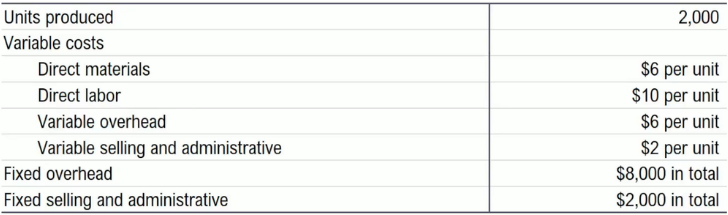
20
22
24
26
Here's what students ask on this topic:
Absorption costing and variable costing differ primarily in how they treat fixed manufacturing overhead. Absorption costing includes all manufacturing costs—direct materials, direct labor, variable manufacturing overhead, and fixed manufacturing overhead—in the unit product cost. Fixed overhead is allocated per unit by dividing total fixed overhead by the number of units produced, as shown in the formula: . Variable costing, on the other hand, includes only variable manufacturing costs (direct materials, direct labor, and variable overhead) in the unit product cost and treats fixed overhead as a period cost, excluding it from the product cost. This results in absorption costing usually having a higher unit product cost than variable costing by the amount of fixed overhead allocated per unit.
To calculate the unit product cost under absorption costing, you add all manufacturing costs, including direct materials, direct labor, variable manufacturing overhead, and fixed manufacturing overhead allocated per unit. First, calculate the fixed overhead per unit by dividing total fixed overhead by the number of units produced: . Then, sum this with the variable costs per unit. For example, if direct materials cost \$1.50, direct labor \$1.00, variable overhead \$0.75, and fixed overhead per unit \$0.25, the total unit product cost is \$3.50. This method ensures all manufacturing costs are assigned to each unit produced.
Selling and administrative costs are excluded from unit product cost calculations because they are considered period costs, not product costs. Product costs are directly tied to the production process and include direct materials, direct labor, and manufacturing overhead. In contrast, selling and administrative expenses relate to activities outside of manufacturing, such as marketing and office management, and are expensed in the period incurred. Therefore, these costs do not get assigned to individual units and are excluded from both absorption and variable costing unit product cost calculations.
Fixed overhead is the key factor causing the difference in unit product cost between absorption and variable costing. Absorption costing assigns fixed manufacturing overhead to each unit by dividing total fixed overhead by the number of units produced, adding this amount to the unit product cost. Variable costing excludes fixed overhead from the unit product cost, treating it as a period expense instead. As a result, absorption costing typically shows a higher unit product cost by the fixed overhead amount allocated per unit. For example, if fixed overhead is \$25,000 and 100,000 units are produced, the fixed overhead per unit is \$0.25, which increases the absorption costing unit product cost by that amount compared to variable costing.
Variable costing relies on actual overhead data because it includes only variable manufacturing costs in the unit product cost, and fixed overhead is treated as a period cost. Unlike absorption costing, which can use predetermined overhead rates to allocate fixed overhead to units, variable costing requires the true, actual variable overhead costs incurred during production to accurately calculate the unit product cost. This ensures that the variable costing method reflects the real costs of production without estimating fixed overhead, providing a more precise measure of variable manufacturing costs per unit.