Cash Budget: Videos & Practice Problems
A Cash Budget shows whether a business will have enough cash to meet its obligations. It combines the beginning cash balance, cash collections, cash disbursements, and financing items to determine the ending cash balance for each period. The core flow is \( \text{Ending cash balance} = \text{Total cash available} - \text{Total cash payments} - \text{Debt repayments} - \text{Interest payments} + \text{New borrowing} \).
To build it clearly, accountants first prepare simple intermediate schedules, especially the cash collections budget and payment schedules for direct materials, direct labor, manufacturing overhead, operating expenses, and capital expenditures. These focus on when cash actually enters or leaves the bank account, not just when costs are recognized. Credit terms matter, and manufacturing overhead often requires removing depreciation because it is a non-cash cost.
The cash budget is usually prepared period by period because one period’s ending cash becomes the next period’s beginning cash. It is used to identify possible cash shortages, evaluate the need for financing, and confirm that the business can maintain a positive cash position.
Overview of the Cash Budget

Which statement best explains the main importance of preparing a cash budget?
To help managers present the company's net worth to investors to obtain more financing.
To help managers ensure sufficient funds to meet obligations and avoid liquidity shortages.
To help managers determine how much dividends will be paid to shareholders.
To help managers record all actual cash transactions after they occur during the period.
Intermediate Documents: Cash Collections Budget
Intermediate Documents: Cash Collections Budget
A furniture maker has set the following budgeted sales for the coming three months:

It is also projected that 60% of total sales would come from credit sales that can be collected a month after the sale is made. What is the total amount of cash expected to be received from customers for the month of May?
\$90,000
\$100,000
\$105,000
\$110,000
Intermediate Documents: Cash Disbursements (Product Costs)
Intermediate Documents: Cash Disbursements (Product Costs)
Intermediate Documents: Cash Disbursements (Product Costs)
Intermediate Documents: Cash Disbursements (Product Costs)
A furniture maker has set the following budgeted product costs for the coming three months:
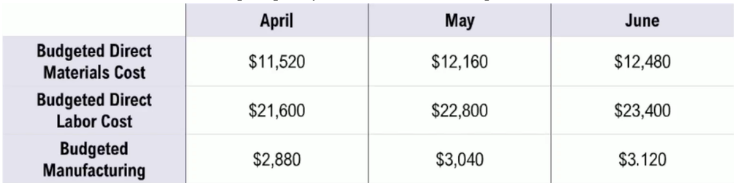
\$500 in manufacturing overhead costs is payable one month later, while labor costs and the remaining manufacturing overhead must be paid at the end of the month. Also, direct materials purchases carry 1-month credit terms. Calculate the total cash payments for product costs for the month of May.
\$36,860
\$38,000
\$37,500
\$37,360
Intermediate Documents: Cash Disbursements (Other Costs)
Intermediate Documents: Cash Disbursements (Other Costs)
Intermediate Documents: Cash Disbursements (Other Costs)
Is it always required that operating expenses be paid in the same period as they are incurred?
Yes, because direct materials purchases are usually settled immediately upon delivery.
No, because payment timing depends on agreed terms, not just when the cost is recognized.
Yes, because all period costs must be expensed immediately.
No, because manufacturing overhead amounts may be paid later depending on supplier arrangements.
Combined Cash Budget
Combined Cash Budget
A furniture maker has set the following expected cash data for the month of May:
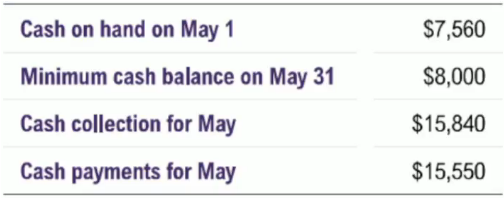
Does the furniture maker need to acquire financing at the end of May?
No, the furniture maker has a positive ending cash balance.
Yes, the furniture maker needs financing equal to \$8,000.
Yes, the furniture maker needs an additional finance of \$150.
No, the furniture maker has an ending cash balance greater than its beginning cash balance.
Here's what students ask on this topic:
A cash budget is a financial plan that helps a business determine if it has enough cash to cover its expenses and obligations. It consolidates all cash inflows, such as cash collections from sales, and cash outflows, including payments for direct materials, labor, overhead, operating expenses, capital expenditures, and financing activities like debt repayments and interest. The main goal is to ensure the company maintains a positive cash balance each period to avoid liquidity shortages. The cash budget starts with the beginning cash balance, adds cash collections, subtracts total cash payments and financing costs, and ends with the ending cash balance, which becomes the next period's beginning balance. This process helps managers plan for cash needs and make informed financial decisions.
Intermediate documents break down complex budgets into simpler, focused schedules that track cash inflows and outflows. For example, the sales budget is simplified into a cash collections budget, which shows when cash from sales is actually received. Similarly, budgets for direct materials, direct labor, manufacturing overhead, operating expenses, and capital expenditures are converted into payment schedules that indicate when cash payments occur. These intermediate documents reduce the complexity of the master budget by condensing detailed information into a few key lines, making it easier to compile the overall cash budget. They also help account for timing differences, such as credit sales or delayed payments, ensuring accurate cash flow projections.
Depreciation is a non-cash expense representing the allocation of the cost of long-term assets over time. Although it reduces reported profit, it does not involve an actual cash outflow during the period. Therefore, when preparing the manufacturing overhead payments schedule for the cash budget, depreciation must be subtracted from total overhead costs to determine the actual cash payments. This adjustment ensures that the cash budget reflects only the cash leaving the business, providing a true picture of cash disbursements related to manufacturing overhead.
Credit sales delay cash inflows because customers pay after the sale date. In the cash collections budget, cash from credit sales is recorded in the period when payment is expected, not when the sale occurs. For example, if credit sales are made in quarter 1 but collected in quarter 2, the cash collections budget will show the cash inflow in quarter 2. This timing difference is crucial for accurate cash budgeting, as it affects when cash is actually available to the business. Understanding credit terms and collection patterns helps managers forecast cash flow and avoid shortages.
The ending cash balance of a quarter represents the cash remaining after all inflows and outflows for that period. This ending balance becomes the beginning cash balance for the next quarter. When preparing the cash budget for the subsequent quarter, this beginning balance is added to the expected cash collections to determine total cash available. This sequential linking ensures continuity and accuracy in cash flow planning across periods. It also helps managers monitor cash levels over time and plan for borrowing or investing excess cash as needed.