Ch. 6 - Confidence Intervals
Larson - Elementary Statistics: Picturing the World 8th Edition
Larson8th EditionElementary Statistics: Picturing the WorldISBN: 9780137493470Not the one you use?Change textbook
Chapter 6, Problem 6.1.34

Finding the Margin of Error In Exercises 33 and 34, use the confidence interval to find the estimated margin of error. Then find the sample mean. Book Prices A store manager reports a confidence interval of (244.07, 280.97) when estimating the mean price (in dollars) for the population of textbooks.

Verified step by step guidance
1
Step 1: Understand the concept of margin of error. The margin of error (E) is half the width of the confidence interval. It represents the maximum expected difference between the true population parameter and the sample estimate within the given confidence level.
Step 2: Calculate the width of the confidence interval by subtracting the lower bound from the upper bound. Use the formula: Width = Upper - Lower. In this case, the upper bound is 280.97 and the lower bound is 244.07.
Step 3: Divide the width of the confidence interval by 2 to find the margin of error. Use the formula: E = Width2.
Step 4: Calculate the sample mean by finding the midpoint of the confidence interval. Use the formula: Mean = Upper + Lower2. This gives the central value of the confidence interval.
Step 5: Summarize the results. The margin of error (E) and the sample mean are the two key values derived from the confidence interval. Ensure all calculations are accurate and clearly interpreted.

Verified video answer for a similar problem:

This video solution was recommended by our tutors as helpful for the problem above.
Video duration:
1m
Was this helpful?

Key Concepts

Here are the essential concepts you must grasp in order to answer the question correctly.

Margin of Error

The margin of error quantifies the uncertainty associated with a sample estimate. It represents the range within which the true population parameter is expected to lie, given a certain confidence level. In the context of a confidence interval, it is calculated as half the width of the interval, indicating how much the sample mean may differ from the actual population mean.
Recommended video:
04:08
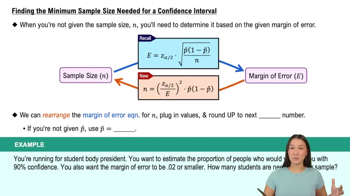
Finding the Minimum Sample Size Needed for a Confidence Interval

Confidence Interval

A confidence interval is a range of values, derived from a sample statistic, that is likely to contain the true population parameter with a specified level of confidence. For example, a 95% confidence interval suggests that if we were to take many samples, approximately 95% of the calculated intervals would contain the true mean. It provides a way to express the reliability of the estimate.
Recommended video:
06:33
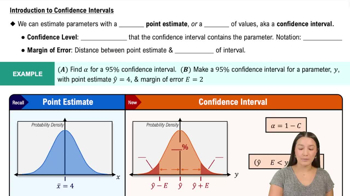
Introduction to Confidence Intervals

Sample Mean

The sample mean is the average value of a set of observations from a sample, calculated by summing all the sample values and dividing by the number of observations. It serves as a point estimate of the population mean and is central to inferential statistics, as it helps in making predictions about the population based on the sample data.
Recommended video:
05:11
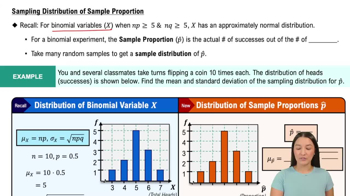
Sampling Distribution of Sample Proportion
Related Practice
Textbook Question

In Exercises 7–10, use the confidence interval to find the margin of error and the sample proportion.

(0.512, 0.596)

117
views
Textbook Question

"Finding p^ and q^ In Exercises 3–6, let p be the population proportion for the situation. Find point estimates of p and q.

Social Security In a survey of 351 retired Americans, 200 said that they rely on Social Security as major source of income. (Adapted from Gallup)"

38
views
Textbook Question

Bisexual Idenfitication In a survey of 692 lesbian, gay, bisexual, or transgender U.S adults, 378 said that they consider themselves bisexual. Construct a 90% confidence interval for the population proportion of lesbian, gay, bisexual, or transgender U.S. adults who consider themselves bisexual. (Adapted from Gallup)

87
views
Textbook Question

Determining a Minimum Sample Size Determine the minimum sample size required when you want to be 99% confident that the sample mean is within two units of the population mean and σ = 1.4. Assume the population is normally distributed.

187
views
Textbook Question

Finding p^ and q^ In Exercises 3–6, let p be the population proportion for the situation. Find point estimates of p and q.

Social Security In a survey of 661 non-retired Americans, 218 said that they expect to rely on Social Security as major source of income when they retire. (Adapted from Gallup)

92
views
Textbook Question

For the same sample statistics, which level of confidence would produce the widest confidence interval? Explain your reasoning.

a. 90%

b. 95%

c. 98%

d. 99%

125
views