Ch. 3 - Probability
Larson - Elementary Statistics: Picturing the World 8th Edition
Larson8th EditionElementary Statistics: Picturing the WorldISBN: 9780137493470Not the one you use?Change textbook
Chapter 3, Problem 3.T.5

5. Use technology to randomly select two numbers from 1 to 6. Find the sum and subtract 1 to obtain a total.
a. What is the theoretical probability of each total from 1 to 11?
b. Use this procedure to select 100 totals from 1 to 11. Tally your results and compare them with the probabilities in part (a).

Verified step by step guidance
1
Step 1: Understand the problem. You are tasked with finding the theoretical probability of each total from 1 to 11 when two numbers are randomly selected from 1 to 6, their sum is calculated, and 1 is subtracted from the sum. Then, you will simulate this process 100 times and compare the results with the theoretical probabilities.
Step 2: Calculate the theoretical probabilities for part (a). First, determine all possible outcomes when rolling two dice (since the numbers are selected from 1 to 6, there are 6 × 6 = 36 possible outcomes). For each pair of dice rolls, calculate the sum of the two numbers and subtract 1. Count how many times each total from 1 to 11 occurs, and divide by the total number of outcomes (36) to find the probability of each total.
Step 3: For part (b), use technology (e.g., a random number generator or statistical software) to simulate rolling two dice 100 times. For each pair of rolls, calculate the sum of the two numbers, subtract 1, and record the resulting total. Tally the frequency of each total from 1 to 11.
Step 4: Compare the simulated frequencies from part (b) with the theoretical probabilities from part (a). To do this, calculate the relative frequency of each total from the simulation by dividing the frequency of each total by 100. Then, compare these relative frequencies to the theoretical probabilities.
Step 5: Analyze the results. Discuss whether the simulated frequencies closely match the theoretical probabilities. If there are discrepancies, consider factors such as the randomness of the simulation or the sample size (100 trials). Larger sample sizes generally lead to results that are closer to theoretical probabilities.

Verified video answer for a similar problem:

This video solution was recommended by our tutors as helpful for the problem above.
Video duration:
2m
Was this helpful?

Key Concepts

Here are the essential concepts you must grasp in order to answer the question correctly.

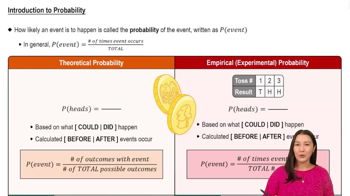
Theoretical Probability

Theoretical probability is the likelihood of an event occurring based on the possible outcomes in a perfect scenario. It is calculated by dividing the number of favorable outcomes by the total number of possible outcomes. In this case, for each total from rolling two dice, the theoretical probability can be determined by analyzing how many combinations yield each total from 2 to 12.
Recommended video:
5:37
Introduction to Probability

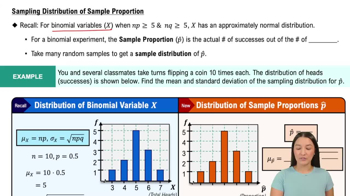
Random Sampling

Random sampling is a technique used to select a subset of individuals from a larger population, ensuring that each individual has an equal chance of being chosen. In this question, randomly selecting totals from rolling two dice simulates the process of gathering data to analyze the distribution of outcomes. This method helps in obtaining a representative sample for comparison with theoretical probabilities.
Recommended video:
05:11
Sampling Distribution of Sample Proportion

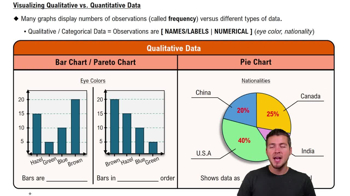
Data Comparison

Data comparison involves analyzing and contrasting two sets of data to identify patterns, discrepancies, or correlations. In this context, after collecting 100 totals from the random sampling, comparing these results with the theoretical probabilities allows for an assessment of how closely the experimental outcomes align with expected probabilities, providing insights into the randomness and fairness of the selection process.
Recommended video:
Guided course
04:39
Visualizing Qualitative vs. Quantitative Data
Related Practice
Textbook Question

5. Which event(s) in Exercise 4 can be considered unusual? Explain your reasoning.

147
views

Textbook Question

66. Access Code An access code consists of six characters. For each character, any letter or number can be used, with the exceptions that the first character cannot be 0 and the last two characters must be odd numbers.

a. What is the probability of randomly selecting the correct access code on the first try?

131
views
Textbook Question

7. There are 16 students giving final presentations in your history course.

b. Presentation subjects are based on the units of the course. Unit B is covered by three students, Unit C is covered by five students, and Units A and D are each covered by four students. How many presentation orders are possible when presentations on

the same unit are indistinguishable from each other?

105
views
Textbook Question

4. The table on the left shows the secondary school student enrollment levels (in thousands by grade) in Oklahoma and Texas schools in a recent year. (Source: U.S. Nation

for Education Statistics)

A student in one of the indicated grades and states is randomly selected. Find the probability of selecting a student who

d. is enrolled in Texas, given that the student is in twelfth grade.

77
views
Textbook Question

4. The table on the left shows the secondary school student enrollment levels (in thousands by grade) in Oklahoma and Texas schools in a recent year. (Source: U.S. Nation

for Education Statistics)

A student in one of the indicated grades and states is randomly selected. Find the probability of selecting a student who

a. is in ninth grade.

107
views
Textbook Question

2. How many possible variations are there in Mozart's Musical Dice Game minuet? Explain.

81
views