
Ch. 6 - Confidence Intervals
Larson - Elementary Statistics: Picturing the World 8th Edition
Larson8th EditionElementary Statistics: Picturing the WorldISBN: 9780137493470Not the one you use?Change textbook
Chapter 6, Problem 6.RSRD.3

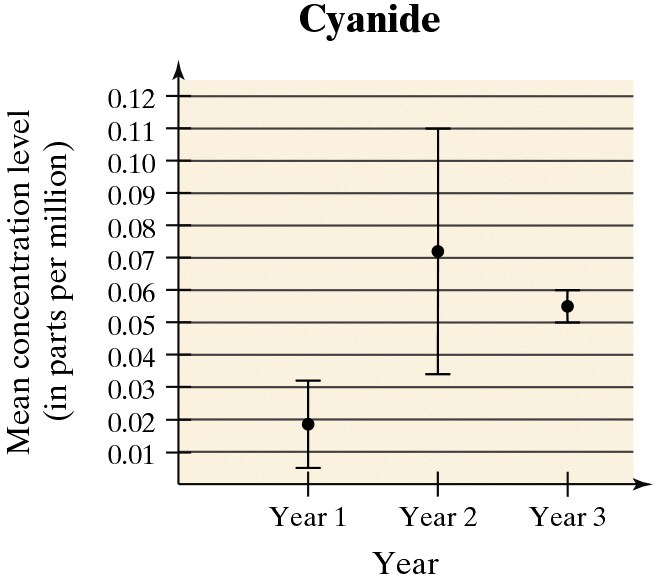
The Safe Drinking Water Act, which was passed in 1974, allows the Environmental Protection Agency (EPA) to regulate the levels of contaminants in drinking water. The EPA requires that water utilities give their customers water quality reports annually. These reports include the results of daily water quality monitoring, which is performed to determine whether drinking water is safe for consumption. A water department tests for contaminants at water treatment plants and at customers’ taps. These contaminants include microorganisms, organic chemicals, and inorganic chemicals, such as cyanide. Cyanide’s presence in drinking water is the result of discharges from steel, plastics, and fertilizer factories. For drinking water, the maximum contaminant level of cyanide is 0.2 parts per million. As part of your job for your city’s water department, you are preparing a report that includes an analysis of the results shown in the figure at the right. The figure shows the point estimates for the population mean concentration and the 95% confidence intervals for cyanide over a three-year period. The data are based on random water samples taken by the city’s three water treatment plants.
<IMAGE>
The confidence interval for Year 2 is much larger than that for the other years. What do you think may have caused this larger confidence level?

Verified step by step guidance
1
Step 1: Observe the graph provided. It shows the mean concentration levels of cyanide (in parts per million) for three years, along with their respective 95% confidence intervals. Note that the confidence interval for Year 2 is significantly larger compared to Years 1 and 3.
Step 2: Recall that the width of a confidence interval is influenced by the variability in the data and the sample size. A larger confidence interval often indicates higher variability in the data or a smaller sample size.
Step 3: Consider potential causes for increased variability in Year 2. This could be due to inconsistent sampling methods, changes in cyanide discharge levels from factories, or environmental factors affecting water quality during that year.
Step 4: Reflect on the possibility of a smaller sample size in Year 2. If fewer water samples were collected, the estimate of the population mean would be less precise, leading to a wider confidence interval.
Step 5: Conclude that the larger confidence interval in Year 2 likely reflects either increased variability in cyanide levels or a reduced sample size. Further investigation into the sampling methods and external factors during Year 2 would be necessary to pinpoint the exact cause.

Verified video answer for a similar problem:

This video solution was recommended by our tutors as helpful for the problem above.
Video duration:
3m
Was this helpful?

Key Concepts

Here are the essential concepts you must grasp in order to answer the question correctly.

Confidence Interval

A confidence interval is a range of values, derived from sample statistics, that is likely to contain the true population parameter. It provides an estimate of uncertainty around a sample mean, indicating how much the sample mean might vary from the actual population mean. A wider confidence interval suggests greater uncertainty about the estimate, often due to variability in the data or a smaller sample size.
Recommended video:
06:33
Introduction to Confidence Intervals

Point Estimate

A point estimate is a single value that serves as an estimate of a population parameter, such as the mean concentration of a contaminant in water. In the context of the question, the point estimate represents the average cyanide concentration for each year based on the sampled data. While point estimates provide a quick summary, they do not convey the variability or uncertainty associated with the estimate.
Recommended video:
06:33
Introduction to Confidence Intervals

Sample Size and Variability

Sample size refers to the number of observations or data points collected in a study. A larger sample size generally leads to more reliable estimates and narrower confidence intervals. Variability, or the spread of data points, can also affect confidence intervals; higher variability in the data can result in wider intervals. The larger confidence interval for Year 2 may indicate increased variability in cyanide levels or a smaller sample size during that year.
Recommended video:
05:11
Sampling Distribution of Sample Proportion
Related Practice
Textbook Question

Use the standard normal distribution or the t-distribution to construct the indicated confidence interval for the population mean of each data set. Justify your decision. If neither distribution can be used, explain why. Interpret the results.

a. In a random sample of 40 patients, the mean waiting time at a dentist’s office was 20 minutes and the standard deviation was 7.5 minutes. Construct a 95% confidence interval for the population mean.

147
views
Textbook Question

The Safe Drinking Water Act, which was passed in 1974, allows the Environmental Protection Agency (EPA) to regulate the levels of contaminants in drinking water. The EPA requires that water utilities give their customers water quality reports annually. These reports include the results of daily water quality monitoring, which is performed to determine whether drinking water is safe for consumption. A water department tests for contaminants at water treatment plants and at customers’ taps. These contaminants include microorganisms, organic chemicals, and inorganic chemicals, such as cyanide. Cyanide’s presence in drinking water is the result of discharges from steel, plastics, and fertilizer factories. For drinking water, the maximum contaminant level of cyanide is 0.2 parts per million. As part of your job for your city’s water department, you are preparing a report that includes an analysis of the results shown in the figure at the right. The figure shows the point estimates for the population mean concentration and the 95% confidence intervals for cyanide over a three-year period. The data are based on random water samples taken by the city’s three water treatment plants.

What can the water department do to decrease the size of the confidence intervals, regardless of the amount of variance in cyanide levels?

84
views
Textbook Question

In Exercises 27–30, find the critical values and for the level of confidence c and sample size n.

c = 0.95, n = 13

97
views
Textbook Question

In Exercises 27–30, find the critical values and for the level of confidence c and sample size n.

c = 0.98, n = 25

73
views
Textbook Question

The data set represents the weights (in pounds) of 10 randomly selected black bears from northeast Pennsylvania. Assume the weights are normally distributed. (Source: Pennsylvania Game Commission)

b. Construct a 95% confidence interval for the population mean. Interpret the results.

76
views
Textbook Question

In a survey of 2096 U.S. adults, 1740 think football teams of all levels should require players who suffer a head injury to take a set amount of time off from playing to recover. (Adapted from The Harris Poll)

a. Find the point estimate for the population proportion.

76
views