Mendel crossed peas having round green seeds with peas having wrinkled yellow seeds. All F₁ plants had seeds that were round and yellow. Predict the results of testcrossing these F₁ plants.
Table of contents
- 1. Introduction to Genetics51m
- 2. Mendel's Laws of Inheritance3h 37m
- 3. Extensions to Mendelian Inheritance2h 41m
- 4. Genetic Mapping and Linkage2h 28m
- 5. Genetics of Bacteria and Viruses1h 21m
- 6. Chromosomal Variation1h 48m
- 7. DNA and Chromosome Structure56m
- 8. DNA Replication1h 10m
- 9. Mitosis and Meiosis1h 34m
- 10. Transcription1h 0m
- 11. Translation58m
- 12. Gene Regulation in Prokaryotes1h 19m
- 13. Gene Regulation in Eukaryotes44m
- 14. Genetic Control of Development44m
- 15. Genomes and Genomics1h 50m
- 16. Transposable Elements47m
- 17. Mutation, Repair, and Recombination1h 6m
- 18. Molecular Genetic Tools19m
- 19. Cancer Genetics29m
- 20. Quantitative Genetics1h 26m
- 21. Population Genetics50m
- 22. Evolutionary Genetics29m
2. Mendel's Laws of Inheritance
Dihybrid Cross
Problem 17a
Textbook Question
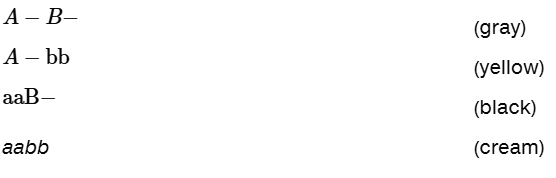
In rats, the following genotypes of two independently assorting autosomal genes determine coat color:

A third gene pair on a separate autosome determines whether or not any color will be produced. The CC and Cc genotypes allow color according to the expression of the A and B alleles. However, the cc genotype results in albino rats regardless of the A and B alleles present. Determine the F₁ phenotypic ratio of the following crosses:
AAbbCC×aaBBcc
Verified step by step guidance1
Identify the genotypes of the parents for all three gene pairs: Parent 1 is AAbbCC and Parent 2 is aaBBcc.
Determine the possible gametes each parent can produce based on their genotypes: Parent 1 can produce gametes with A b C alleles, and Parent 2 can produce gametes with a B c alleles.
Combine the gametes from each parent to find the F₁ offspring genotypes: all offspring will have genotype AaBbCc.
Analyze the effect of the third gene (C locus) on coat color: since all offspring have at least one C allele (Cc), color will be expressed according to the A and B alleles.
Use the A and B alleles in the offspring (AaBb) to determine the phenotype based on the given dominance relationships: A–B– results in gray coat color.
Verified video answer for a similar problem:This video solution was recommended by our tutors as helpful for the problem above
Video duration:
4mPlay a video:
Was this helpful?
Key Concepts
Here are the essential concepts you must grasp in order to answer the question correctly.
Independent Assortment of Genes
Independent assortment refers to the principle that genes located on different chromosomes segregate independently during gamete formation. This means the inheritance of one gene does not affect the inheritance of another, allowing for new combinations of alleles in offspring. In this question, the A, B, and C genes assort independently, influencing coat color phenotypes.
Recommended video:
Guided course
Gamete Genetics and Independent Assortment
Epistasis and Gene Interaction
Epistasis occurs when one gene masks or modifies the expression of another gene. Here, the C gene controls whether color is produced at all; the cc genotype causes albinism regardless of A and B alleles. This is an example of recessive epistasis, where the homozygous recessive genotype at one locus masks the effects of other loci.
Recommended video:
Guided course
Interacting Genes Overview
Genotype to Phenotype Mapping
Understanding how specific genotypes translate into phenotypes is crucial. The A and B genes determine coat color combinations (gray, yellow, black, cream) based on dominant and recessive alleles, while the C gene controls color presence. Correctly interpreting these relationships allows prediction of offspring phenotypes from parental genotypes.
Recommended video:
Guided course
Mapping with Markers
Related Videos
Related Practice
Textbook Question
665
views
