
Ch. 19 - Heat and the First Law of Thermodynamics
Giancoli Douglas - Physics for Scientists and Engineers 5th edition
Giancoli Douglas5th editionPhysics for Scientists and EngineersISBN: 9780137488179Not the one you use?Change textbook
Chapter 19, Problem 94

A diesel engine accomplishes ignition without a spark plug by an adiabatic compression of air to a temperature above the ignition temperature of the diesel fuel, which is injected into the cylinder at the peak of the compression. Suppose air is taken into the cylinder at 280 K and volume V₁ and is compressed adiabatically to 560° C ( ≈ 1000 °F) and volume V₂. Assuming that the air behaves as an ideal gas whose ratio of CP to CV is 1.4, calculate the compression ratio V₁/ V₂ of the engine.

Verified step by step guidance
1
Step 1: Understand the problem and identify the key concepts. The problem involves an adiabatic process, where no heat is exchanged with the surroundings. The relationship between temperature and volume during an adiabatic process for an ideal gas is governed by the equation: \( T_1 V_1^{\gamma - 1} = T_2 V_2^{\gamma - 1} \), where \( \gamma \) is the ratio of \( C_P \) to \( C_V \).
Step 2: Convert the given temperatures into Kelvin. The initial temperature \( T_1 \) is given as 280 K, and the final temperature \( T_2 \) is given as 560°C. To convert \( T_2 \) to Kelvin, use the formula \( T(K) = T(°C) + 273.15 \). Thus, \( T_2 = 560 + 273.15 \).
Step 3: Rearrange the adiabatic equation to solve for the compression ratio \( V_1 / V_2 \). Using the equation \( T_1 V_1^{\gamma - 1} = T_2 V_2^{\gamma - 1} \), divide both sides by \( T_2 \) and isolate \( V_1 / V_2 \): \( \frac{V_1}{V_2} = \left( \frac{T_2}{T_1} \right)^{\frac{1}{\gamma - 1}} \).
Step 4: Substitute the known values into the equation. \( T_1 = 280 \), \( T_2 = 560 + 273.15 \), and \( \gamma = 1.4 \). Plug these values into the formula \( \frac{V_1}{V_2} = \left( \frac{T_2}{T_1} \right)^{\frac{1}{\gamma - 1}} \).
Step 5: Simplify the expression for \( \frac{V_1}{V_2} \) without calculating the final numerical value. Ensure the exponent \( \frac{1}{\gamma - 1} \) is correctly applied, where \( \gamma - 1 = 1.4 - 1 = 0.4 \). The compression ratio can now be expressed as \( \frac{V_1}{V_2} = \left( \frac{T_2}{T_1} \right)^{2.5} \).

Key Concepts

Here are the essential concepts you must grasp in order to answer the question correctly.

Adiabatic Process

An adiabatic process is a thermodynamic process in which no heat is exchanged with the surroundings. In the context of a diesel engine, this means that the air inside the cylinder is compressed rapidly enough that it does not lose heat to the environment, leading to a significant increase in temperature. This principle is crucial for understanding how the air can reach ignition temperatures without external heating.
Recommended video:
Guided course
06:13
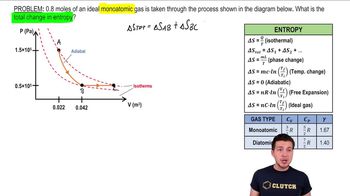
Entropy & Ideal Gas Processes

Ideal Gas Law

The Ideal Gas Law relates the pressure, volume, and temperature of an ideal gas through the equation PV = nRT. In this scenario, the behavior of air as an ideal gas allows us to apply this law to calculate changes in volume and temperature during the adiabatic compression. Understanding this relationship is essential for determining the compression ratio and the resulting thermodynamic properties of the gas.
Recommended video:
Guided course
07:21
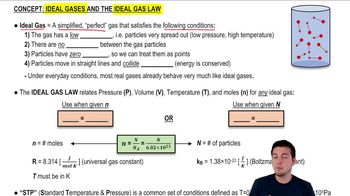
Ideal Gases and the Ideal Gas Law

Compression Ratio

The compression ratio is defined as the ratio of the volume of the cylinder before compression (V₁) to the volume after compression (V₂). It is a critical parameter in engine design, influencing efficiency and power output. In this question, calculating the compression ratio helps to understand how effectively the engine compresses air to achieve the necessary conditions for diesel fuel ignition.
Recommended video:
Guided course
17:42
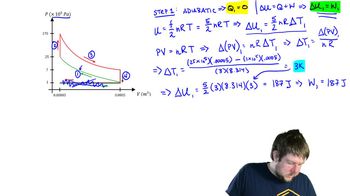
Finding the Compression Ratio