
Ch. 7 - Estimating Parameters and Determining Sample Sizes
Triola - Elementary Statistics 14th Edition
Triola14th EditionElementary StatisticsISBN: 9780137366446Not the one you use?Change textbook
Chapter 7, Problem 7.1.33a

E-Cigarettes A New York Times article reported that a survey conducted in 2014 included 36,000 adults, with 3.7% of them being regular users of e-cigarettes. Because e-cigarette use is relatively new, there is a need to obtain today’s usage rate. How many adults must be surveyed now if we want a confidence level of 95% and a margin of error of 1.5 percentage points?


a. Assume that nothing is known about the rate of e-cigarette usage among adults.

Verified step by step guidance
1
Step 1: Identify the formula for determining the required sample size for estimating a population proportion. The formula is: n = (Z^2 * p * (1 - p)) / E^2, where n is the required sample size, Z is the z-score corresponding to the desired confidence level, p is the estimated population proportion, and E is the margin of error.
Step 2: Determine the values for the variables in the formula. Since the confidence level is 95%, the corresponding z-score (Z) is approximately 1.96. The margin of error (E) is given as 1.5%, which should be converted to a decimal: E = 0.015. Since nothing is known about the rate of e-cigarette usage, we use the most conservative estimate for p, which is 0.5 (this maximizes the product p * (1 - p)).
Step 3: Substitute the values into the formula. Replace Z with 1.96, p with 0.5, and E with 0.015 in the formula: n = (1.96^2 * 0.5 * (1 - 0.5)) / 0.015^2.
Step 4: Simplify the numerator of the formula. Calculate 1.96^2, then multiply it by 0.5 and (1 - 0.5). This will give you the value of the numerator.
Step 5: Simplify the denominator of the formula. Square the margin of error (0.015^2), then divide the numerator by the denominator to find the required sample size (n). Round up to the nearest whole number, as sample size must be an integer.

Verified video answer for a similar problem:

This video solution was recommended by our tutors as helpful for the problem above.
Video duration:
2m
Was this helpful?

Key Concepts

Here are the essential concepts you must grasp in order to answer the question correctly.

Sample Size Calculation

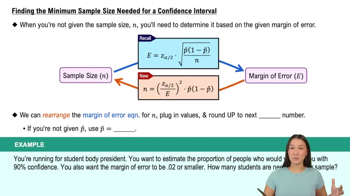
Sample size calculation is a statistical method used to determine the number of observations or replicates needed in a study to achieve a desired level of precision. It takes into account the confidence level, margin of error, and variability in the population. In this case, we need to calculate how many adults should be surveyed to estimate the current e-cigarette usage rate with a specified confidence level and margin of error.
Recommended video:
05:11
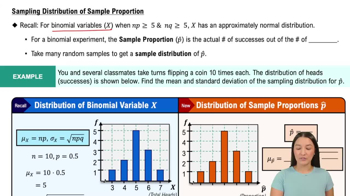
Sampling Distribution of Sample Proportion

Confidence Level

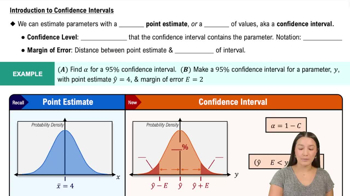
The confidence level represents the degree of certainty that the population parameter lies within the confidence interval. A 95% confidence level means that if we were to take 100 different samples and compute a confidence interval for each sample, approximately 95 of those intervals would contain the true population parameter. This concept is crucial for understanding the reliability of the survey results.
Recommended video:
06:33
Introduction to Confidence Intervals

Margin of Error

The margin of error indicates the range within which the true population parameter is expected to fall, based on the sample data. A margin of error of 1.5 percentage points means that the estimate of e-cigarette usage could be 1.5 percentage points higher or lower than the sample result. This concept is essential for assessing the precision of the survey findings and ensuring that the results are statistically valid.
Recommended video:
04:08
Finding the Minimum Sample Size Needed for a Confidence Interval
Related Practice
Textbook Question

Controversial Song The song “Baby It’s Cold Outside” generated much controversy because of its lyrics and tone. CBS New York conducted a survey by asking viewers to use the Internet to respond to a question asking whether that song was really too offensive to play. Among 1043 Internet users who chose to respond, 986 said that the song was not too offensive, and 57 of the respondents said that the song was too offensive.


a. Construct a 95% confidence interval estimate of the proportion of the population having the belief that the song is not too offensive.


75
views
Textbook Question

Comparing Waiting Lines


The values listed below are waiting times (in minutes) of customers at the Jefferson Valley Bank, where customers enter a single waiting line that feeds three teller windows. Construct a 95% confidence interval for the population standard deviation sigma.

131
views
Textbook Question

Cell Phone Radiation Here is a sample of measured radiation emissions (cW/kg) for cell phones (based on data from the Environmental Working Group): 38, 55, 86, 145. Here are ten bootstrap samples:

[Image]


a. Using only the ten given bootstrap samples, construct an 80% confidence interval estimate of the population mean.


107
views
Textbook Question

Critical Thinking. In Exercises 17–28, use the data and confidence level to construct a confidence interval estimate of p, then address the given question.


Touch Therapy When she was 9 years of age, Emily Rosa did a science fair experiment in which she tested professional touch therapists to see if they could sense her energy field. She flipped a coin to select either her right hand or her left hand, and then she asked the therapists to identify the selected hand by placing their hand just under Emily’s hand without seeing it and without touching it. Among 280 trials, the touch therapists were correct 123 times (based on data in “A Close Look at Therapeutic Touch,” Journal of the American Medical Association, Vol. 279, No. 13).


a. Given that Emily used a coin toss to select either her right hand or her left hand, what proportion of correct responses would be expected if the touch therapists made random guesses?

145
views
Textbook Question

Archeology Archeologists have studied sizes of Egyptian skulls in an attempt to determine whether breeding occurred between different cultures. Listed below are the widths (mm) of skulls from 150 A.D. (based on data from Ancient Races of the Thebaid by Thomson and Randall-Maciver).


a. Use 1000 bootstrap samples to construct a 99% confidence interval estimate of the mean skull width.


95
views
Textbook Question

Mean Pulse Rate of Males Data Set 1 “Body Data” in Appendix B includes pulse rates of 153 randomly selected adult males, and those pulse rates vary from a low of 40 bpm to a high of 104 bpm. Find the minimum sample size required to estimate the mean pulse rate of adult males. Assume that we want 99% confidence that the sample mean is within 2 bpm of the population mean.


a. Find the sample size using the range rule of thumb to estimate .


115
views