Explain the difference between the z-test for μ using a P-value and the z-test for μ using rejection region(s).
Verified step by step guidance
1
The z-test for μ (population mean) is a hypothesis test used to determine if a sample mean significantly differs from a hypothesized population mean. Both the P-value approach and the rejection region approach are methods to make a decision in hypothesis testing, but they differ in how the decision is reached.
Step 1: In the P-value approach, calculate the test statistic (z) using the formula: , where is the sample mean, is the hypothesized population mean, is the population standard deviation, and is the sample size.
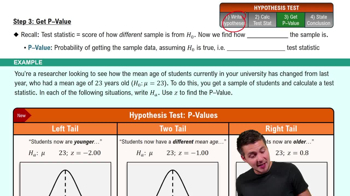
Step 2: Using the calculated z-value, find the corresponding P-value from the standard normal distribution table. The P-value represents the probability of observing a test statistic as extreme as, or more extreme than, the one calculated, assuming the null hypothesis is true.
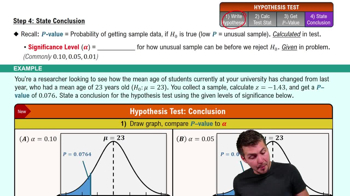
Step 3: Compare the P-value to the significance level (α). If the P-value is less than or equal to α, reject the null hypothesis. Otherwise, fail to reject the null hypothesis.
Step 4: In the rejection region approach, determine the critical z-value(s) based on the significance level (α) and the type of test (one-tailed or two-tailed). For example, in a two-tailed test with α = 0.05, the critical z-values are approximately ±1.96.
Step 5: Compare the calculated z-value to the critical z-value(s). If the z-value falls within the rejection region (beyond the critical z-value(s)), reject the null hypothesis. Otherwise, fail to reject the null hypothesis. The key difference is that the P-value approach provides a probability, while the rejection region approach uses a fixed cutoff point for decision-making.
Verified video answer for a similar problem:
This video solution was recommended by our tutors as helpful for the problem above
Video duration:
2m
Play a video:
0 Comments
Key Concepts
Here are the essential concepts you must grasp in order to answer the question correctly.
Z-test
A Z-test is a statistical method used to determine whether there is a significant difference between the means of two groups or between a sample mean and a population mean. It assumes that the data follows a normal distribution and is typically applied when the sample size is large (n > 30) or the population variance is known. The test calculates a Z-score, which indicates how many standard deviations an element is from the mean.
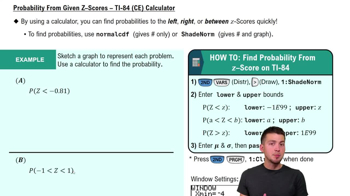
Probability From Given Z-Scores - TI-84 (CE) Calculator
P-value
The P-value is a measure that helps determine the significance of results obtained in a statistical test. It represents the probability of observing the test results, or something more extreme, assuming that the null hypothesis is true. A smaller P-value indicates stronger evidence against the null hypothesis, with common thresholds being 0.05 or 0.01, below which the null hypothesis is typically rejected.
The rejection region is a range of values for the test statistic that leads to the rejection of the null hypothesis in a hypothesis test. It is determined based on the significance level (alpha) and the distribution of the test statistic. If the calculated test statistic falls within this region, it suggests that the observed data is unlikely under the null hypothesis, prompting researchers to reject it in favor of the alternative hypothesis.