Ch. 20 - Second Law of Thermodynamics
Giancoli Douglas - Physics for Scientists and Engineers 5th edition
Giancoli Douglas5th editionPhysics for Scientists and EngineersISBN: 9780137488179Not the one you use?Change textbook
Chapter 20, Problem ]70

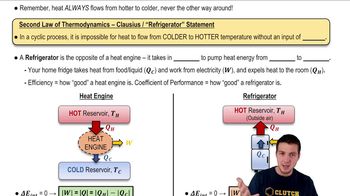
Refrigeration units can be rated in “tons.” A 1-ton air conditioning system can remove sufficient energy to freeze 1 ton (2000 pounds = 909 kg) of 0°C water into 0°C ice in one 24-h day. Assume the hot part of a day averages 35°C and the interior of a house is maintained at 22°C by the continuous operation of a 6-ton air conditioning system for 6 hours a day. How much does this cooling cost the homeowner per day, and per month?Assume the work done by the refrigeration unit is powered by electricity that costs \$0.13 per kWh and that the unit’s coefficient of performance is only 18% of an ideal refrigerator. 1 kWh = 3.60 x 10⁶ J .

Verified step by step guidance
1
Step 1: Understand the problem and identify the key quantities. The air conditioning system is rated at 6 tons, and each ton corresponds to the energy required to freeze 1 ton (909 kg) of water at 0°C into ice at 0°C in 24 hours. The coefficient of performance (COP) of the system is 18% of an ideal refrigerator. The system operates for 6 hours a day, and electricity costs \$0.13 per kWh. We need to calculate the daily and monthly costs of cooling.
Step 2: Calculate the energy removed by the air conditioning system in one day. The energy required to freeze 1 ton of water is given by the latent heat of fusion of water, which is approximately 334,000 J/kg. Multiply this by the mass of 1 ton of water (909 kg) to find the energy for 1 ton. Then, multiply this by 6 (since the system is rated at 6 tons) to find the total energy removed in 24 hours. Finally, scale this energy down to 6 hours of operation per day.
Step 3: Determine the work done by the air conditioning system. The coefficient of performance (COP) is defined as the ratio of the heat removed (Q_c) to the work done (W). For an ideal refrigerator, the COP is given by COP_ideal = T_c / (T_h - T_c), where T_c and T_h are the temperatures of the cold and hot reservoirs in Kelvin, respectively. Convert the given temperatures (22°C and 35°C) to Kelvin and calculate COP_ideal. Then, multiply COP_ideal by 0.18 to account for the system's efficiency. Use the relationship COP = Q_c / W to solve for W (work done).
Step 4: Convert the work done into energy cost. The work done (W) will be in joules, so convert it to kilowatt-hours (kWh) using the conversion factor 1 kWh = 3.60 × 10⁶ J. Multiply the work in kWh by the cost of electricity (\$0.13 per kWh) to find the daily cost of cooling. To find the monthly cost, multiply the daily cost by the number of days in a month (assume 30 days for simplicity).
Step 5: Summarize the results. The daily cost of cooling is obtained from the previous step, and the monthly cost is simply the daily cost multiplied by 30. Ensure all units are consistent and verify the calculations for accuracy.

Verified video answer for a similar problem:

This video solution was recommended by our tutors as helpful for the problem above.
Video duration:
15m
Was this helpful?

Key Concepts

Here are the essential concepts you must grasp in order to answer the question correctly.

Coefficient of Performance (COP)

The Coefficient of Performance (COP) is a measure of the efficiency of a refrigeration or air conditioning system. It is defined as the ratio of the heat removed from the cooled space to the work input required to remove that heat. A higher COP indicates a more efficient system, meaning it can provide more cooling for less energy consumed. In this scenario, the COP is given as 18% of the ideal value, which affects the overall energy consumption and cost calculations.
Recommended video:
Guided course
06:47
Refrigerators

Energy Consumption Calculation

To determine the energy consumption of the air conditioning system, one must calculate the total cooling load it needs to handle. This involves understanding how much heat is removed from the interior space over a specified time. The energy consumed can be calculated using the formula: Energy (in kWh) = Cooling Load (in kWh) / COP. This calculation is essential for estimating the cost of electricity used by the system.
Recommended video:
Guided course
05:01
Calculating Max Height with Energy Conservation

Cost of Electricity

The cost of electricity is a critical factor in determining the overall expense of operating an air conditioning system. It is calculated by multiplying the total energy consumed (in kWh) by the cost per kWh. In this case, the electricity cost is given as $0.13 per kWh. Understanding this concept allows homeowners to estimate their daily and monthly expenses based on the energy consumption of their cooling systems.
Recommended video:
Guided course
05:43
Electric Flux
Related Practice
Textbook Question

Suppose that you repeatedly shake six coins in your hand and drop them on the floor. Construct a table showing the number of microstates that correspond to each macrostate. What is the probability of obtaining six heads?

919
views

Textbook Question

(II) Calculate the probabilities, when you throw two dice, of obtaining a 7.

992
views
Textbook Question

1.00 mole of an ideal monatomic gas at STP first undergoes an isothermal expansion so that the volume at b is 2.5 times the volume at a (Fig. 20–25). Next, heat is extracted at a constant volume so that the pressure drops. The gas is then compressed adiabatically back to the original state. Calculate the pressures at b and c.

1584
views
Textbook Question

(II) Calculate the probabilities, when you throw two dice, of obtaining an 11.

1066
views
Textbook Question

At a steam power plant, steam engines work in pairs, the heat output of the first one being the approximate heat input of the second. The operating temperatures of the first are 750°C and 440°C, and of the second 415°C and 240°C. If the heat of combustion of coal is 2.8 x 10⁷ J/kg, at what rate must coal be burned if the plant is to put out 950 MW of power? Assume the efficiency of the engines is 65% of the ideal (Carnot) efficiency.

1352
views
Textbook Question

Two 1100-kg cars are traveling 75 km/h in opposite directions when they collide and are brought to rest. Estimate the change in entropy of the universe as a result of this collision. Assume T = 20°C.

1410
views