

Ch 17: Superposition
Knight Calc - Physics for Scientists and Engineers 5th Edition
Knight Calc5th EditionPhysics for Scientists and EngineersISBN: 9780137344796Not the one you use?Change textbook
Chapter 17, Problem 45

In a laboratory experiment, one end of a horizontal string is tied to a support while the other end passes over a frictionless pulley and is tied to a 1.5 kg sphere. Students determine the frequencies of standing waves on the horizontal segment of the string, then they raise a beaker of water until the hanging 1.5 kg sphere is completely submerged. The frequency of the fifth harmonic with the sphere submerged exactly matches the frequency of the third harmonic before the sphere was submerged. What is the diameter of the sphere?

Verified step by step guidance
1
Step 1: Understand the problem. The frequency of standing waves on a string depends on the tension in the string and the linear mass density. The tension in the string is provided by the weight of the sphere. When the sphere is submerged in water, the buoyant force reduces the effective weight of the sphere, thereby reducing the tension in the string. The problem involves matching the frequencies of the fifth harmonic (with the sphere submerged) and the third harmonic (before submersion).
Step 2: Write the formula for the frequency of standing waves on a string. The frequency of the nth harmonic is given by: f=n2Tμ where n is the harmonic number, T is the tension in the string, and μ is the linear mass density of the string. Note that the linear mass density remains constant throughout the problem.
Step 3: Relate the tension in the string to the weight of the sphere. Before submersion, the tension is equal to the weight of the sphere: T=mg where m is the mass of the sphere (1.5 kg) and g is the acceleration due to gravity. When the sphere is submerged, the tension is reduced by the buoyant force: T=mg-ρVg where ρ is the density of water and V is the volume of the sphere.
Step 4: Use the condition that the fifth harmonic frequency with the sphere submerged matches the third harmonic frequency before submersion. Equate the two frequencies: 52Tμ=32Tμ Substitute the expressions for tension before and after submersion into this equation and simplify to solve for the volume V of the sphere.
Step 5: Relate the volume of the sphere to its diameter. The volume of a sphere is given by: V=43π(d2)3 where d is the diameter of the sphere. Solve for d using the volume obtained in the previous step.

Verified video answer for a similar problem:

This video solution was recommended by our tutors as helpful for the problem above.
Video duration:
7m
Was this helpful?

Key Concepts

Here are the essential concepts you must grasp in order to answer the question correctly.

Standing Waves

Standing waves are formed when two waves of the same frequency and amplitude travel in opposite directions and interfere with each other. In a string fixed at both ends, these waves create nodes (points of no displacement) and antinodes (points of maximum displacement). The frequency of standing waves is determined by the length of the string and the tension in it, leading to specific harmonics that can be observed in experiments.
Recommended video:
Guided course
07:58
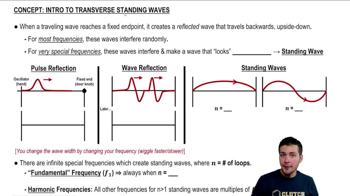
Intro to Transverse Standing Waves

Harmonics

Harmonics are specific frequencies at which a system can oscillate, resulting in standing waves. The fundamental frequency is the first harmonic, while higher harmonics are integer multiples of this frequency. In the context of the string, the third harmonic corresponds to a specific pattern of nodes and antinodes, and understanding the relationship between different harmonics is crucial for analyzing the effects of changes in the system, such as submerging the sphere.
Recommended video:
Guided course
07:52
Simple Harmonic Motion of Pendulums

Buoyancy and Displacement

Buoyancy is the upward force exerted by a fluid on an object submerged in it, which is equal to the weight of the fluid displaced by the object. When the sphere is submerged, it displaces a volume of water equal to its own volume, affecting the tension in the string and consequently the frequency of the standing waves. The relationship between the submerged object's volume and the frequency of the harmonics is key to determining the sphere's diameter.
Recommended video:
Guided course
11:06
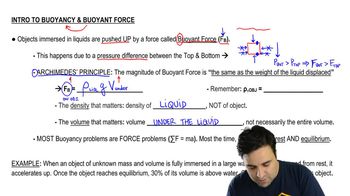
Intro to Buoyancy & Buoyant Force
Related Practice
Textbook Question

BIO Deep-sea divers often breathe a mixture of helium and oxygen to avoid getting the 'bends' from breathing high-pressure nitrogen. The helium has the side effect of making the divers' voices sound odd. Although your vocal tract can be roughly described as an open-closed tube, the way you hold your mouth and position your lips greatly affects the standing-wave frequencies of the vocal tract. This is what allows different vowels to sound different. The 'ee' sound is made by shaping your vocal tract to have standing-wave frequencies at, normally, 270 Hz and 2300 Hz. What will these frequencies be for a helium-oxygen mixture in which the speed of sound at body temperature is 750m/s ? The speed of sound in air at body temperature is 350m/s .

1977
views
Textbook Question

A string under tension has a fundamental frequency of 220 Hz. What is the fundamental frequency if the tension is doubled?

2643
views
Textbook Question

A 280 Hz sound wave is directed into one end of the trombone slide seen in FIGURE P17.55. A microphone is placed at the other end to record the intensity of sound waves that are transmitted through the tube. The straight sides of the slide are 80 cm in length and 10 cm apart with a semicircular bend at the end. For what slide extensions s will the microphone detect a maximum of sound intensity?

2051
views
Textbook Question

A violinist places her finger so that the vibrating section of a 1.0 g/m string has a length of 30 cm, then she draws her bow across it. A listener nearby in a 20°C room hears a note with a wavelength of 40 cm. What is the tension in the string?

1307
views
Textbook Question

INT One end of a 75-cm-long, 2.5 g guitar string is attached to a spring. The other end is pulled, which stretches the spring. The guitar string's second harmonic occurs at 550 Hz when the spring has been stretched by 5.0 cm. What is the value of the spring constant?

1866
views
Textbook Question

Tendons are, essentially, elastic cords stretched between two fixed ends. As such, they can support standing waves. A woman has a 20-cm-long Achilles tendon—connecting the heel to a muscle in the calf—with a cross-section area of 90 mm2 . The density of tendon tissue is 1100 kg/m3. For a reasonable tension of 500 N, what will be the fundamental frequency of her Achilles tendon?

1326
views