Cash Budget: Videos & Practice Problems
A Cash Budget brings together all expected cash inflows and cash disbursements to show whether a business has enough cash to meet its obligations and avoid a negative cash balance. It starts with the beginning cash balance, adds cash collections, and determines total cash available. From there, the business subtracts cash payments for direct materials, direct labor, manufacturing overhead, operating expenses, and capital expenditures, along with financing items such as debt repayments and interest.
The key challenge is timing: expenses may be recognized in one period but paid in another, and sales may be made in one period but collected later. That is why a cash collections budget and several payment schedules are prepared first. For manufacturing overhead, depreciation must be removed because it is a non-cash cost, so cash payments are based on \(\text{Cash payment}=\text{Manufacturing overhead}-\text{Depreciation}\).
The final figure is the ending cash balance, found from total cash available less cash payments and financing outflows, plus any new borrowing if needed. This ending balance becomes the next period’s beginning cash balance, so the budget is built period by period.
Overview of the Cash Budget

Which statement best explains the main importance of preparing a cash budget?
To help managers present the company's net worth to investors to obtain more financing.
To help managers ensure sufficient funds to meet obligations and avoid liquidity shortages.
To help managers determine how much dividends will be paid to shareholders.
To help managers record all actual cash transactions after they occur during the period.
Intermediate Documents: Cash Collections Budget
Intermediate Documents: Cash Collections Budget
A furniture maker has set the following budgeted sales for the coming three months:

It is also projected that 60% of total sales would come from credit sales that can be collected a month after the sale is made. What is the total amount of cash expected to be received from customers for the month of May?
\$90,000
\$100,000
\$105,000
\$110,000
Intermediate Documents: Cash Disbursements (Product Costs)
Intermediate Documents: Cash Disbursements (Product Costs)
Intermediate Documents: Cash Disbursements (Product Costs)
Intermediate Documents: Cash Disbursements (Product Costs)
A furniture maker has set the following budgeted product costs for the coming three months:
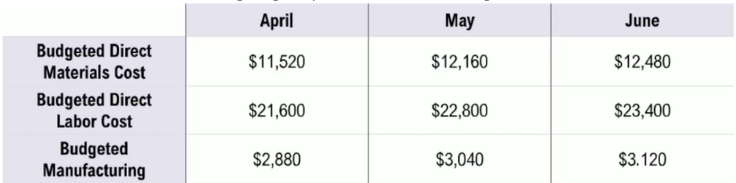
\$500 in manufacturing overhead costs is payable one month later, while labor costs and the remaining manufacturing overhead must be paid at the end of the month. Also, direct materials purchases carry 1-month credit terms. Calculate the total cash payments for product costs for the month of May.
\$36,860
\$38,000
\$37,500
\$37,360
Intermediate Documents: Cash Disbursements (Other Costs)
Intermediate Documents: Cash Disbursements (Other Costs)
Intermediate Documents: Cash Disbursements (Other Costs)
Is it always required that operating expenses be paid in the same period as they are incurred?
Yes, because direct materials purchases are usually settled immediately upon delivery.
No, because payment timing depends on agreed terms, not just when the cost is recognized.
Yes, because all period costs must be expensed immediately.
No, because manufacturing overhead amounts may be paid later depending on supplier arrangements.
Combined Cash Budget
Combined Cash Budget
A furniture maker has set the following expected cash data for the month of May:
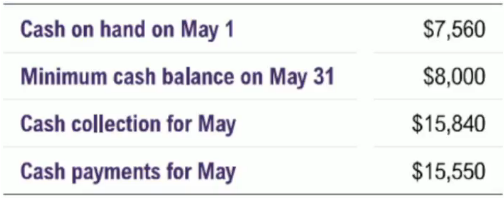
Does the furniture maker need to acquire financing at the end of May?
No, the furniture maker has a positive ending cash balance.
Yes, the furniture maker needs financing equal to \$8,000.
Yes, the furniture maker needs an additional finance of \$150.
No, the furniture maker has an ending cash balance greater than its beginning cash balance.
Here's what students ask on this topic:
A cash budget is a crucial part of the master budget that helps a business determine if it has enough incoming cash to cover all cash disbursements. Unlike other budgets that record revenue or costs when they are earned or incurred, the cash budget focuses on the timing of actual cash inflows and outflows. This helps the business avoid liquidity shortages by ensuring that cash is available when needed. The cash budget combines information from various parts of the master budget, such as sales, direct materials, labor, overhead, operating expenses, and capital expenditures, to provide a clear picture of cash availability throughout the budget period.
Intermediate documents simplify the cash budget preparation by condensing complex budget information into a few key lines that focus on actual cash movements. For example, the sales budget is simplified into the cash collections budget, which tracks when cash is received from sales, including cash sales and collections from credit sales. Similarly, budgets for direct materials, direct labor, manufacturing overhead, operating expenses, and capital expenditures are converted into payment schedules that show when cash payments occur. These intermediate documents make it easier to compile the cash budget by providing clear, concise data on cash inflows and outflows.
The cash collections budget is prepared by extracting information from the sales budget about when cash is actually received. It includes three main components: cash sales made in the current quarter, collections from credit sales made in previous quarters, and the total cash collections for the quarter. Since some sales are on credit, cash is often collected in later periods. For example, credit sales made in quarter 1 might be collected in quarter 2. The cash collections budget summarizes these timings to show the actual cash inflows, which is essential for accurate cash budgeting.
Depreciation is a non-cash expense included in manufacturing overhead costs, representing the allocation of the cost of assets over time rather than an actual cash outflow. Since the cash budget tracks actual cash payments, depreciation must be excluded to avoid overstating cash disbursements. The cash payments for manufacturing overhead are calculated as: . This ensures the cash budget reflects only the cash that leaves the business for overhead expenses.
The ending cash balance is calculated by starting with the beginning cash balance, adding total cash collections, and then subtracting all cash payments, including payments for product costs, operating expenses, capital expenditures, and financing activities such as debt repayments and interest. The formula is: . This calculation is done for each quarter, and the ending balance of one quarter becomes the beginning balance of the next.
Timing is critical in cash budgeting because cash inflows and outflows often occur in different periods than when sales or expenses are recorded. For example, credit sales generate revenue when made, but cash is collected later, requiring the cash collections budget to track when payments are received. Similarly, purchases on credit may be recorded in one period, but cash payments are made in a subsequent period, affecting the direct materials payments schedule. Accurately reflecting these timing differences ensures the cash budget shows the true cash position of the business at any point in time.