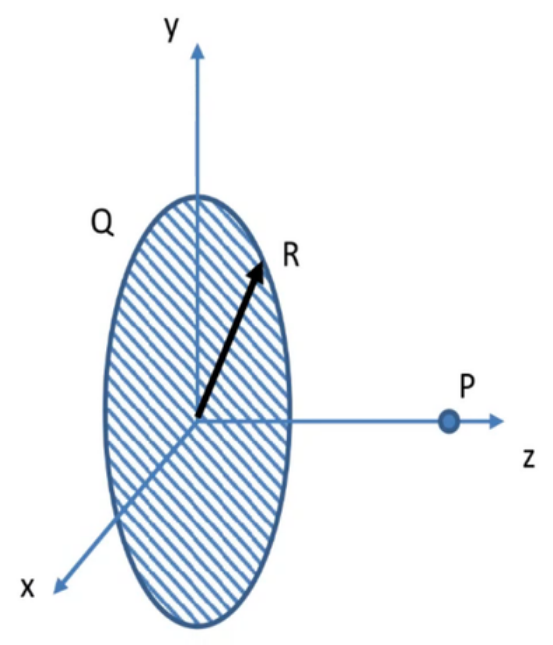
The electric potential difference, often called the potential difference, can be rigorously defined using calculus. It is the difference in electric potential between two points and is related to the electric field through the integral of the electric field vector dotted with an infinitesimal displacement vector. Mathematically, the potential difference ΔV between two points is expressed as the negative integral of the electric field E dotted with the differential displacement d𝑥:
\[\Delta V = - \int \mathbf{E} \cdot d\mathbf{x}\]
This integral accounts for variations in the electric field along the path between the two points. When the electric field is constant, this relationship simplifies to the familiar formula:
\[E = -\frac{\Delta V}{\Delta x}\]
which shows that the electric field is the negative rate of change of the electric potential with respect to distance.
For point charges, the electric potential at a distance R from a charge Q is given by the equation:
\[V = \frac{kQ}{R}\]
where k is Coulomb's constant, approximately equal to 8.99 × 10⁹ N·m²/C². However, when dealing with a distribution of charges rather than a single point charge, the total potential at a point is found by integrating the contributions from each infinitesimal charge element dQ. Each element contributes a small potential dV given by:
\[dV = \frac{k \, dQ}{r}\]
where r is the distance from the charge element to the point of interest. Summing these contributions through integration yields the total potential due to the charge distribution.
To illustrate the use of calculus in calculating potential difference, consider a point charge Q located at the origin along the x-axis. The goal is to find the potential difference between a point at distance R from the charge and a point infinitely far away. Since the electric field from a point charge varies with distance as:
\[\mathbf{E} = \frac{kQ}{x^2} \hat{i}\]
the potential difference is calculated by integrating the electric field from R to infinity:
\[\Delta V = - \int_{R}^{\infty} \frac{kQ}{x^2} \, dx = -kQ \int_{R}^{\infty} x^{-2} \, dx\]
Evaluating the integral gives:
\[\Delta V = -kQ \left[-\frac{1}{x}\right]_{R}^{\infty} = kQ \left(0 - \frac{1}{R}\right) = -\frac{kQ}{R}\]
This result confirms that the potential at a distance R from a point charge is indeed V = kQ/R, consistent with the known formula. The negative sign indicates the direction of potential decrease as one moves away from the charge.
Understanding the relationship between electric field and potential difference through calculus is essential for analyzing complex charge distributions and varying fields. It highlights how the electric potential is a scalar quantity derived from the vector electric field and how integration plays a crucial role in calculating potentials in non-uniform fields.