Which of the following could be considered the most recent common ancestor of living tetrapods? a. A sturdy-finned, shallow-water lobe-fin whose appendages had skeletal supports similar to those of terrestrial vertebrates b. An armored, jawed placoderm with two pairs of appendages c. An early ray-finned fish that developed bony skeletal supports in its paired fins d. A salamander that had legs supported by a bony skeleton but moved with the side-to-side bending typical of fishes
Verified step by step guidance
1
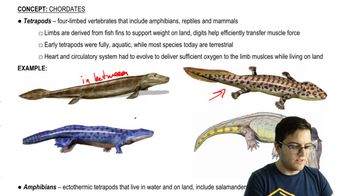
Understand the concept of tetrapods: Tetrapods are vertebrates with four limbs, including amphibians, reptiles, birds, and mammals. They evolved from lobe-finned fishes.
Identify key evolutionary traits: The transition from aquatic to terrestrial life involved the development of limbs with skeletal supports that could bear weight on land.
Analyze option a: A sturdy-finned, shallow-water lobe-fin with appendages having skeletal supports similar to terrestrial vertebrates suggests a transitional form between aquatic and terrestrial life.
Consider the evolutionary timeline: Lobe-finned fishes are known to be ancestors of tetrapods, as they possess limb-like structures that could evolve into legs.
Evaluate the other options: Options b, c, and d describe organisms that either do not fit the evolutionary timeline or lack the necessary adaptations for terrestrial life, such as the armored placoderm or the ray-finned fish.
Verified video answer for a similar problem:
This video solution was recommended by our tutors as helpful for the problem above
Video duration:
37s
Play a video:
Was this helpful?
Key Concepts
Here are the essential concepts you must grasp in order to answer the question correctly.
Tetrapods
Tetrapods are vertebrates with four limbs, including amphibians, reptiles, birds, and mammals. They evolved from lobe-finned fishes during the Devonian period, adapting to life on land. Understanding tetrapods involves studying their evolutionary transition from aquatic to terrestrial environments, which is marked by changes in limb structure and function.
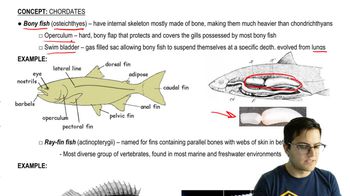
Lobe-finned fish, or Sarcopterygii, are characterized by fleshy, lobed, paired fins, which are supported by a single bone. These fish are crucial in the study of vertebrate evolution as they are believed to be the ancestors of tetrapods. Their fin structure provided the basis for the development of limbs in terrestrial vertebrates, making them a key focus in understanding the transition from water to land.
A common ancestor in evolutionary biology refers to an organism from which two or more species have evolved. Identifying the most recent common ancestor of tetrapods involves examining fossil records and morphological traits that link modern tetrapods to their aquatic predecessors. This concept is essential for tracing evolutionary pathways and understanding the shared characteristics among diverse species.