Plane mirrors produce images that are always the same size as the object, which can limit their usefulness when magnification is needed. To create larger or smaller images, curved mirrors, also known as spherical mirrors, are used. Unlike plane mirrors that reflect light according to the law of reflection with images appearing the same distance behind the mirror, spherical mirrors focus light to a specific point called the focal point, labeled as F.
When parallel rays of light, often referred to as paraxial rays, strike a concave mirror (a mirror shaped like a cave, curving inward), they reflect and converge at the focal point. The focal length, denoted as f, is the distance from the mirror’s vertex (the center of the mirror surface) to this focal point. This focal length is related to the radius of curvature R of the mirror by the equation:
\[f = \frac{R}{2}\]
Here, R is the radius of curvature, which is the distance from the vertex to the center of curvature C, the center of the sphere from which the mirror segment is taken. This relationship is fundamental in understanding how concave mirrors focus light.
Unlike plane mirrors that produce virtual images (images that appear to be behind the mirror and cannot be projected onto a screen), concave mirrors can produce real images. Real images occur because the reflected rays actually converge at a point in front of the mirror. This means if a screen is placed at the focal point, the image can be projected and seen directly. This principle is essential in devices like telescopes, which gather light from distant objects and focus it to form clear images.
For example, consider a concave mirror with a radius of curvature of 3.4 meters pointed at the sun. Since sunlight arrives as parallel rays, these rays will focus at the mirror’s focal point. Using the formula for focal length, the distance from the mirror to the focal point is:
\[f = \frac{3.4\, \text{m}}{2} = 1.7\, \text{m}\]
This means all the sunlight will converge 1.7 meters from the mirror’s surface. This focusing effect is the basis for solar power plants, where concentrated sunlight heats water to generate energy.

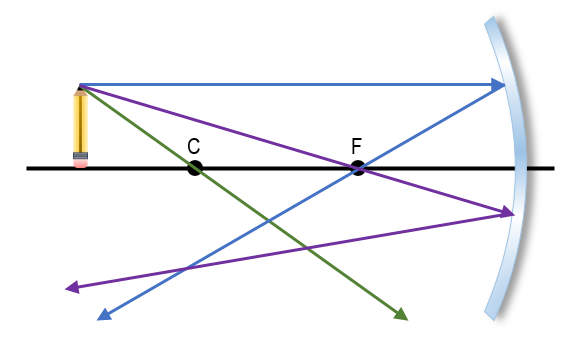
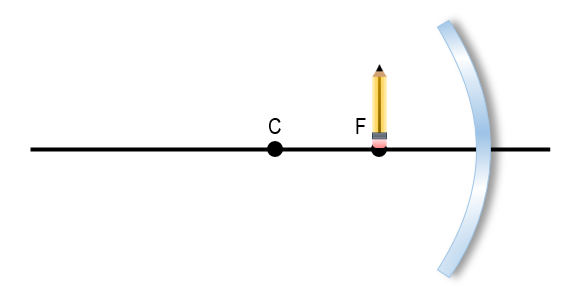
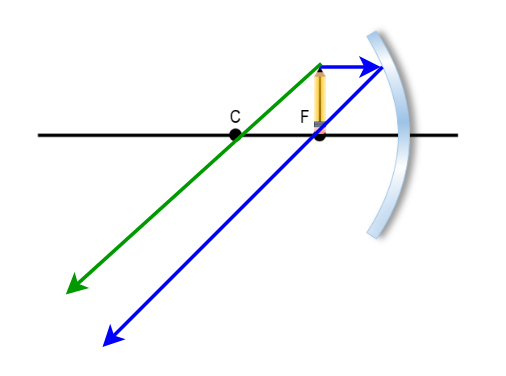 ; at infinity
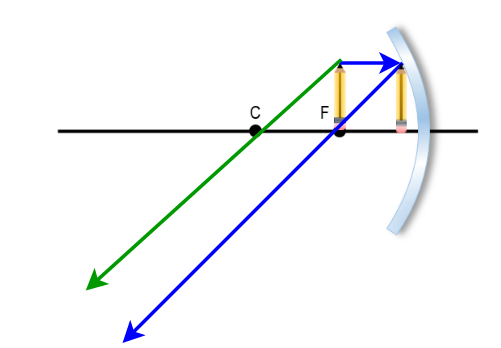 ; between the mirror and the focal point
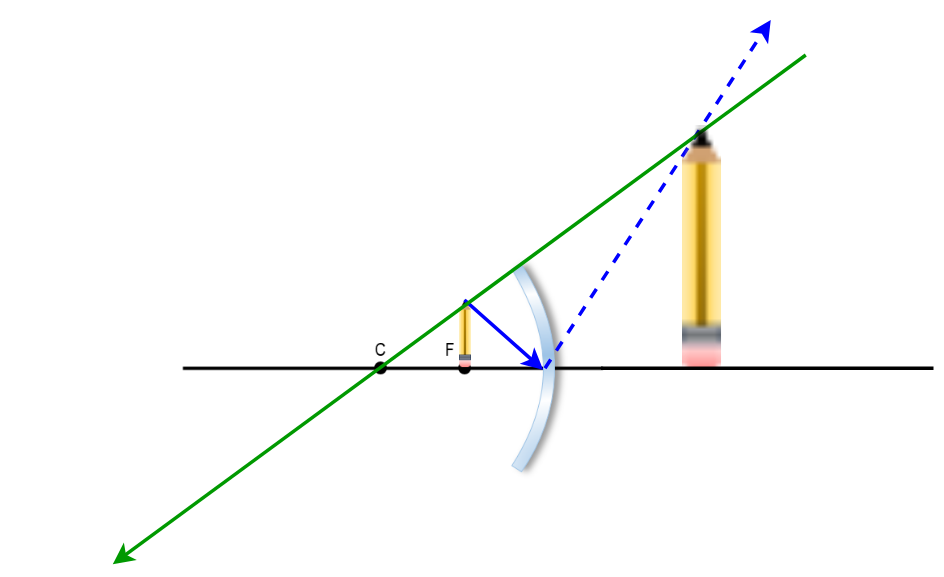 ; behind the mirror
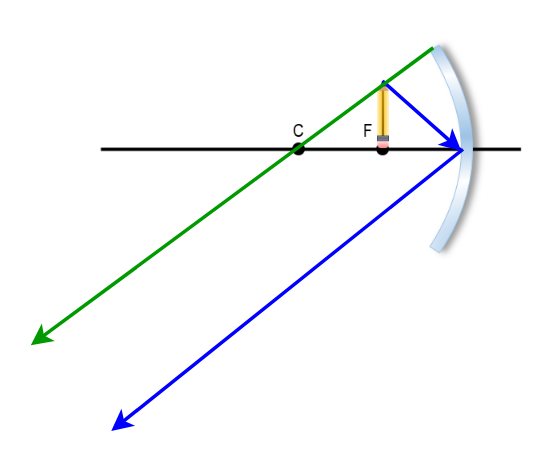 ;at infinity