Join thousands of students who trust us to help them ace their exams!
Multiple Choice
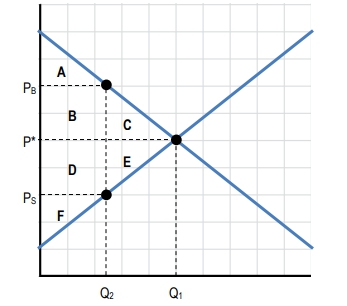
If a tax has caused the market-clearing quantity to fall to Q2, what is total economic surplus?
A
The area of (A) and (F)
B
The area of (D), (E), and (F)
C
The area of (A), (B), (D), and (F)
D
The area of (A), (B), (C), (D), (E), and (F)
E
The area of (C) and (E)
0 Comments
Verified step by step guidance
1
Identify the initial market equilibrium without tax, which is at quantity Q1 and price P*. This is where the supply and demand curves intersect.
Understand that the imposition of a tax shifts the supply curve upwards by the amount of the tax, leading to a new equilibrium at quantity Q2, with buyers paying price PB and sellers receiving price PS.
Recognize that the total economic surplus in a market is the sum of consumer surplus and producer surplus. Consumer surplus is the area above the price level and below the demand curve, while producer surplus is the area below the price level and above the supply curve.
With the tax in place, the consumer surplus is reduced to the area above PB and below the demand curve, which is area A. The producer surplus is reduced to the area below PS and above the supply curve, which is area F.
The total economic surplus after the tax is the sum of the consumer surplus and producer surplus at the new quantity Q2, which includes areas A, B, D, and F. This is because areas B and D are part of the surplus that remains after the tax, representing the portions of consumer and producer surplus that are not lost to the tax wedge.


 Verified step by step guidance

