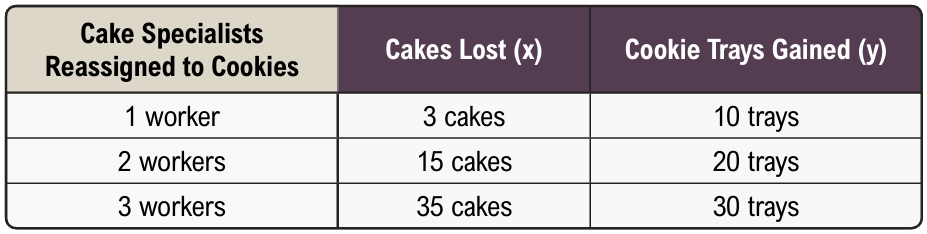
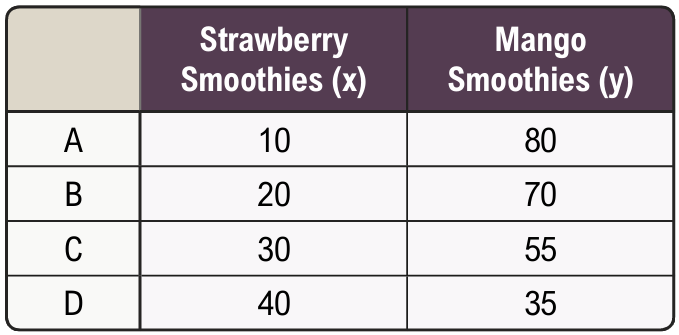
The law of increasing opportunity cost explains that as production of a particular good increases, the marginal opportunity cost also rises. This principle arises because resources are not equally efficient at producing every good. For example, if you try to increase production of one item, you will face progressively larger sacrifices in the production of another item. This concept is crucial in understanding trade-offs in resource allocation.
Consider a company producing two products: pants and shirts. Suppose the company hires two types of workers—Peters, who are highly efficient at making pants (producing 2 pairs per day) but less efficient at making shirts (1 shirt per day), and Shirleys, who excel at making shirts (2 shirts per day) but are less effective at making pants (1 pair per day). Assigning these workers to the tasks they perform best maximizes production efficiency.
Initially, if 50 Shirleys are assigned to the shirt factory, producing 100 shirts, and 100 Peters plus 50 Shirleys work in the pants factory, producing 250 pairs of pants, the company achieves a balanced output. However, if demand for shirts increases and the company wants to produce 200 shirts, shifting more Shirleys to shirt production increases shirt output but reduces pants production to 200 pairs. This trade-off results in losing 50 pairs of pants to gain 100 shirts, which is a reasonable exchange.
When the company attempts to produce 300 shirts by moving all Peters to shirt production, pants production drops to zero. This shift causes a loss of 200 pairs of pants to gain an additional 100 shirts, illustrating the increasing opportunity cost. The marginal cost of producing more shirts rises because less efficient resources (Peters) are used for shirt production, leading to greater sacrifices in pants output.
This example highlights how different resources have varying efficiencies, and reallocating them involves trade-offs. The law of increasing opportunity cost emphasizes that as production shifts toward one good, the opportunity cost of producing additional units increases, reflecting diminishing returns on resource reallocation. Understanding this concept is essential for making informed decisions about resource management and production strategies in both microeconomic and macroeconomic contexts.