The black dots that cover strawberries are actually fruits formed from the separate carpels of a single flower. The fleshy and tasty portion of a strawberry derives from the receptacle of a flower with many separate carpels. Therefore, a strawberry is: a. A simple fruit with many seeds b. Both a multiple fruit and an accessory fruit c. Both a simple fruit and an aggregate fruit d. Both an aggregate fruit and an accessory fruit
Verified step by step guidance
1
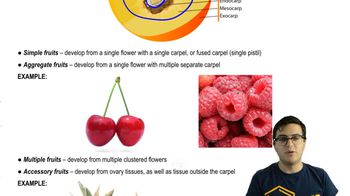
Understand the definition of an aggregate fruit: It is formed from a single flower with multiple carpels, each developing into a small fruit. The black dots on strawberries are the individual fruits from separate carpels, indicating an aggregate fruit.
Recognize the definition of an accessory fruit: It is a fruit where some of the flesh is derived not from the ovary but from some adjacent tissue exterior to the carpel. In strawberries, the fleshy part is derived from the receptacle, making it an accessory fruit.
Analyze the options: A simple fruit develops from a single carpel or several fused carpels, which does not apply to strawberries. A multiple fruit forms from a cluster of flowers, which also does not apply.
Eliminate incorrect options: Option a is incorrect because strawberries are not simple fruits. Option b is incorrect because strawberries are not multiple fruits. Option c is incorrect because strawberries are not simple fruits.
Conclude with the correct option: Based on the definitions and analysis, the correct answer is d, as strawberries are both aggregate fruits and accessory fruits.
Verified video answer for a similar problem:
This video solution was recommended by our tutors as helpful for the problem above
Video duration:
3m
Play a video:
Was this helpful?
Key Concepts
Here are the essential concepts you must grasp in order to answer the question correctly.
Aggregate Fruit
An aggregate fruit develops from a single flower that has multiple carpels, each forming a small fruitlet. These fruitlets cluster together to form the entire fruit. Strawberries are an example, where each black dot on the surface is an individual fruitlet, making the strawberry an aggregate fruit.
An accessory fruit is one where some of the flesh is derived not from the ovary but from some adjacent tissue exterior to the carpel. In strawberries, the fleshy part we eat is derived from the receptacle of the flower, not the ovaries, classifying it as an accessory fruit.
A carpel is the female reproductive part of a flower, consisting of an ovary, a stigma, and usually a style. In strawberries, each carpel develops into a small individual fruit, which is why the surface of a strawberry is covered with tiny, seed-like structures, each representing a separate carpel's fruit.