
Pearson+ LogoPearson+ Logo
Ch. 50 - Sensory and Motor Mechanisms
Campbell - Campbell Biology 11th Edition
Urry11th EditionCampbell BiologyISBN: 9789357423311Not the one you use?Change textbook
Chapter 50, Problem 1

Which of the following sensory receptors is incorrectly paired with its category?
a. Hair cell—mechanoreceptor
b. Snake pit organ—thermoreceptor
c. Taste receptor—chemoreceptor
d. Olfactory receptor—electromagnetic receptor

Verified step by step guidance
1
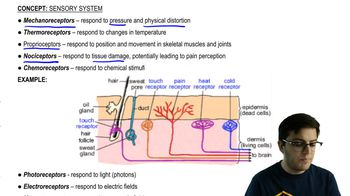
Understand the categories of sensory receptors: Mechanoreceptors respond to mechanical forces, thermoreceptors detect temperature changes, chemoreceptors respond to chemical stimuli, and electromagnetic receptors detect electromagnetic energy such as light.
Analyze each option to determine if the sensory receptor is correctly paired with its category.
Option a: Hair cells are involved in detecting sound and balance, which are mechanical processes, so they are correctly paired with mechanoreceptors.
Option b: Snake pit organs detect infrared radiation, which is related to temperature, so they are correctly paired with thermoreceptors.
Option d: Olfactory receptors detect chemical signals in the air, so they should be paired with chemoreceptors, not electromagnetic receptors. This indicates that option d is incorrectly paired.

Verified video answer for a similar problem:

This video solution was recommended by our tutors as helpful for the problem above.
Video duration:
58s
Was this helpful?

Key Concepts

Here are the essential concepts you must grasp in order to answer the question correctly.

Sensory Receptors

Sensory receptors are specialized cells or structures that detect and respond to specific stimuli from the environment. They convert these stimuli into electrical signals that can be interpreted by the nervous system. Different types of receptors are categorized based on the type of stimulus they detect, such as mechanoreceptors, thermoreceptors, chemoreceptors, and electromagnetic receptors.
Recommended video:
Guided course
02:54
Sensory Receptors

Mechanoreceptors

Mechanoreceptors are sensory receptors that respond to mechanical pressure or distortion. They are involved in detecting touch, vibration, and sound, and are found in various parts of the body, including the skin and inner ear. Hair cells in the inner ear are a type of mechanoreceptor that play a crucial role in hearing and balance by detecting sound waves and head movements.
Recommended video:
Guided course
02:54
Sensory Receptors

Thermoreceptors

Thermoreceptors are sensory receptors that detect changes in temperature. They are essential for maintaining homeostasis by allowing organisms to perceive and respond to temperature variations in their environment. The snake pit organ is an example of a thermoreceptor, specialized for detecting infrared radiation, which helps snakes sense warm-blooded prey even in the dark.
Recommended video:
Guided course
02:54
Sensory Receptors