Which of the following forms of membrane transport require specific membrane proteins? a. Diffusion b. Exocytosis c. Facilitated diffusion d. Active transport e. Facilitated diffusion and active transport
Verified step by step guidance
1
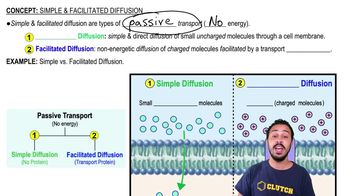
Understand the different types of membrane transport mechanisms: Diffusion is the passive movement of molecules from high to low concentration without requiring membrane proteins. Exocytosis involves vesicle fusion with the membrane to release contents and does not require specific membrane proteins for transport. Facilitated diffusion and active transport, however, both require specific membrane proteins.
Recall that facilitated diffusion is a passive transport mechanism where molecules move down their concentration gradient with the help of specific membrane proteins, such as channel or carrier proteins.
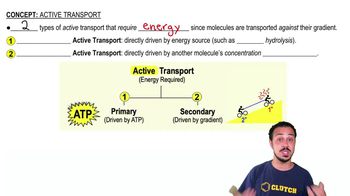
Recognize that active transport is an energy-dependent process where molecules are moved against their concentration gradient using specific membrane proteins, often referred to as pumps (e.g., sodium-potassium pump).
Analyze the options provided: Diffusion and exocytosis do not require specific membrane proteins for transport, while facilitated diffusion and active transport do.
Conclude that the correct answer is the option that includes both facilitated diffusion and active transport, as these are the forms of membrane transport requiring specific membrane proteins.
Verified video answer for a similar problem:
This video solution was recommended by our tutors as helpful for the problem above
Video duration:
35s
Play a video:
Was this helpful?
Key Concepts
Here are the essential concepts you must grasp in order to answer the question correctly.
Membrane Transport
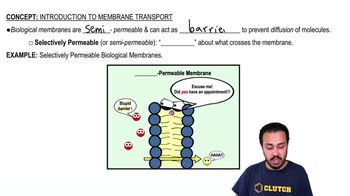
Membrane transport refers to the mechanisms by which substances move across the cell membrane. This process is crucial for maintaining cellular homeostasis and involves various methods, including passive and active transport. Understanding these mechanisms helps in grasping how cells interact with their environment and regulate internal conditions.
Facilitated diffusion is a type of passive transport that requires specific membrane proteins to help move molecules across the cell membrane. Unlike simple diffusion, which occurs directly through the lipid bilayer, facilitated diffusion allows larger or polar molecules, such as glucose, to enter or exit the cell efficiently. This process does not require energy, as it relies on the concentration gradient.
Active transport is a process that moves substances against their concentration gradient, requiring energy, usually in the form of ATP. This mechanism is essential for maintaining concentration differences of ions and molecules across the membrane, which is vital for various cellular functions. Specific membrane proteins, such as pumps, are involved in this process, making it distinct from passive transport methods.