Telomerase synthesizes DNA in the _____ direction.
Verified step by step guidance
1
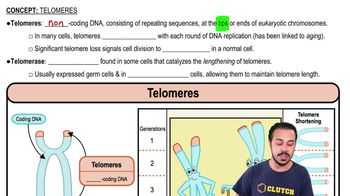
Understand the role of telomerase: Telomerase is an enzyme that adds repetitive nucleotide sequences to the ends of chromosomes, known as telomeres, to prevent them from shortening during cell division.
Recognize the direction of DNA synthesis: DNA synthesis typically occurs in the 5' to 3' direction. This means that new nucleotides are added to the 3' end of the growing DNA strand.
Identify the template used by telomerase: Telomerase uses an RNA template that is part of the enzyme itself to extend the 3' end of the DNA strand.
Consider the mechanism of telomerase action: Telomerase binds to the 3' end of the telomere and uses its RNA component to synthesize DNA in the 5' to 3' direction, extending the telomere.
Review the importance of telomerase: By extending telomeres, telomerase plays a crucial role in cellular aging and cancer, as it allows cells to divide without losing important DNA sequences.
Verified video answer for a similar problem:
This video solution was recommended by our tutors as helpful for the problem above
Video duration:
1m
Play a video:
Was this helpful?
Key Concepts
Here are the essential concepts you must grasp in order to answer the question correctly.
Telomerase Function
Telomerase is an enzyme that adds repetitive nucleotide sequences to the ends of chromosomes, known as telomeres. This process helps prevent the loss of important DNA sequences during cell division, thereby maintaining chromosome integrity and stability. Telomerase is particularly active in stem cells and cancer cells, where it supports continuous cell division.
DNA synthesis occurs in the 5' to 3' direction, meaning that new nucleotides are added to the 3' end of the growing DNA strand. This directionality is due to the enzymatic mechanism of DNA polymerases, which require a free 3' hydroxyl group to add new nucleotides. Telomerase, like other DNA polymerases, follows this 5' to 3' synthesis rule.
Telomeres are repetitive nucleotide sequences at the ends of linear chromosomes, protecting them from degradation and fusion with neighboring chromosomes. In humans, the sequence is typically TTAGGG, repeated thousands of times. Telomeres shorten with each cell division, and telomerase helps counteract this shortening in certain cell types, contributing to cellular longevity.