Join thousands of students who trust us to help them ace their exams!
Multiple Choice
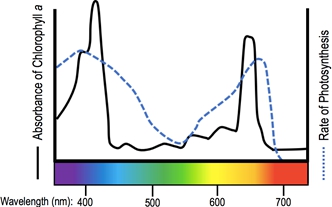
The figure shows the absorption spectrum for chlorophyll a and the action spectrum for photosynthesis. Why are they different?
a) Green and yellow wavelengths of light inhibit the absorption of red and blue wavelengths. b) Oxygen given off during photosynthesis interferes with the absorption of light. c) Accessory pigments are absorbing light in addition to chlorophyll a which can be used in photosynthesis. d) Aerobic bacteria take up oxygen, which changes the measurement of the rate of photosynthesis.
A
Green and yellow wavelengths of light inhibit the absorption of red and blue wavelengths.
B
Oxygen given off during photosynthesis interferes with the absorption of light.
C
Accessory pigments are absorbing light in addition to chlorophyll a which can be used in photosynthesis.
D
Aerobic bacteria take up oxygen, which changes the measurement of the rate of photosynthesis.
0 Comments
Verified step by step guidance
1
Examine the absorption spectrum of chlorophyll a, which shows peaks in the blue (around 450 nm) and red (around 680 nm) regions of the spectrum, indicating that chlorophyll a absorbs these wavelengths most effectively.
Observe the action spectrum for photosynthesis, which indicates the overall rate of photosynthesis across different wavelengths. Notice that it also shows high activity in the blue and red regions but has additional peaks not present in the chlorophyll a absorption spectrum.
Understand that the difference between the absorption spectrum of chlorophyll a and the action spectrum for photosynthesis suggests that other pigments are involved in capturing light energy. These accessory pigments absorb light at different wavelengths and transfer the energy to chlorophyll a, enhancing photosynthesis.
Consider the role of accessory pigments such as chlorophyll b, carotenoids, and xanthophylls, which absorb light in the green and yellow regions (500-600 nm) and contribute to the action spectrum by broadening the range of light that can be used for photosynthesis.
Conclude that the presence of accessory pigments explains why the action spectrum for photosynthesis is broader than the absorption spectrum of chlorophyll a alone, supporting the correct answer: Accessory pigments are absorbing light in addition to chlorophyll a which can be used in photosynthesis.