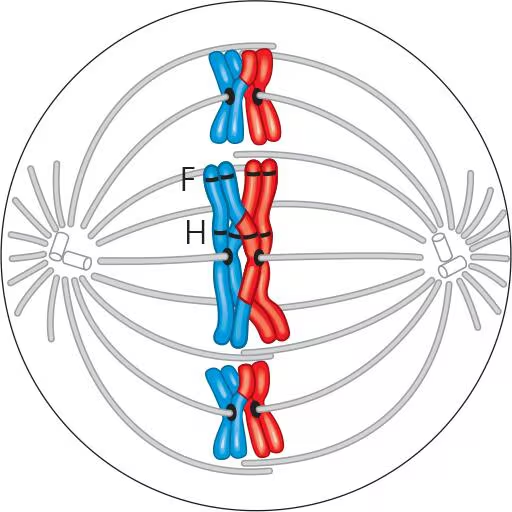
The diagram shows a cell in meiosis. Label the appropriate structures with these terms: chromosome (label as duplicated or unduplicated), centromere, kinetochore, sister chromatids, nonsister chromatids, homologous pair (use a bracket when labeling), homolog (label each one), chiasma, sister chromatid cohesion, and gene loci, labeling the alleles of the F and H genes.
Verified step by step guidance
1
Identify the stage of meiosis depicted in the diagram. This will help determine the arrangement of chromosomes and other structures.
Locate the chromosomes in the diagram. Determine if they are duplicated (consisting of sister chromatids) or unduplicated. Label them accordingly.
Find the centromere on each chromosome, which is the region where sister chromatids are joined. Label the centromere and the kinetochore, which is the protein structure on the centromere where spindle fibers attach.
Identify the homologous pairs of chromosomes. Use a bracket to label the homologous pair and label each homolog within the pair.
Locate the chiasma, which is the point where nonsister chromatids exchange genetic material during crossing over. Label the chiasma and indicate the sister chromatid cohesion, which is the connection between sister chromatids. Finally, label the gene loci for the F and H genes, indicating the alleles present.
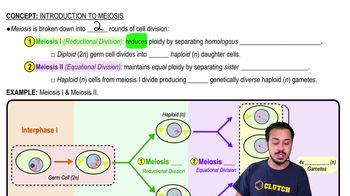
Verified video answer for a similar problem:
This video solution was recommended by our tutors as helpful for the problem above
Video duration:
2m
Play a video:
Was this helpful?
Key Concepts
Here are the essential concepts you must grasp in order to answer the question correctly.
Meiosis
Meiosis is a type of cell division that reduces the chromosome number by half, resulting in four haploid cells. It consists of two stages: meiosis I and meiosis II. Meiosis I separates homologous chromosomes, while meiosis II separates sister chromatids. This process is crucial for sexual reproduction and genetic diversity.
Chromosomes are structures within cells that contain DNA and proteins. During meiosis, chromosomes can be duplicated or unduplicated. Duplicated chromosomes consist of two sister chromatids joined at the centromere. Key structures include the kinetochore, which is the attachment site for spindle fibers, and the centromere, which holds sister chromatids together.
Genetic recombination occurs during meiosis when homologous chromosomes exchange genetic material at points called chiasmata. This process increases genetic variation by producing new combinations of alleles. Gene loci are specific locations on chromosomes where genes are found, and alleles are different versions of a gene that can be inherited.