Why do the tropics and the windward side of mountains receive more rainfall than areas around latitudes 30° north and south and the leeward side of mountains? a. Rising warm, moist air cools and drops its moisture as rain. b. Descending air condenses, creating clouds and rain. c. There is more solar radiation in the tropics and on the windward side of mountains. d. Earth's rotation creates seasonal differences in rainfall.
Verified step by step guidance
1
Step 1: Understand the role of warm, moist air in rainfall. Warm air can hold more moisture than cool air. When warm, moist air rises, it cools as it reaches higher altitudes. Cooling reduces the air's capacity to hold moisture, leading to condensation and precipitation.
Step 2: Examine the tropics. The tropics receive more solar radiation, which warms the air and increases evaporation, leading to higher moisture content in the atmosphere. This warm, moist air rises due to convection, cools, and results in frequent rainfall.
Step 3: Analyze the windward side of mountains. When moist air encounters a mountain, it is forced to rise. As the air rises, it cools and condenses, forming clouds and precipitation. This process is known as orographic lift.
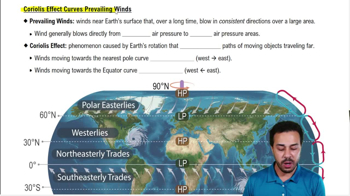
Step 4: Contrast with latitudes 30° north and south. These regions are typically dominated by descending air from the Hadley cell circulation. Descending air is dry because it has already lost its moisture during its upward journey near the equator. This creates arid conditions, such as deserts.
Step 5: Contrast with the leeward side of mountains. After air releases its moisture on the windward side, it descends on the leeward side. Descending air warms and becomes dry, creating a rain shadow effect and resulting in less rainfall.
Verified video answer for a similar problem:

This video solution was recommended by our tutors as helpful for the problem above
Video duration:
2m
Play a video:
Was this helpful?
Key Concepts
Here are the essential concepts you must grasp in order to answer the question correctly.
Adiabatic Cooling
Adiabatic cooling occurs when air rises and expands in the atmosphere, leading to a decrease in temperature. As warm, moist air ascends, it cools, causing the water vapor to condense into droplets, resulting in precipitation. This process is crucial for understanding why tropical regions and windward mountain slopes receive more rainfall.
The rain shadow effect describes the phenomenon where one side of a mountain range receives significant rainfall while the opposite side remains dry. As air rises over the mountains, it cools and loses moisture, leading to lush vegetation on the windward side, while the leeward side experiences arid conditions due to descending dry air.
Hadley cells are large-scale atmospheric circulation patterns that occur between the equator and about 30° latitude. Warm air rises at the equator, cools, and then descends around 30° latitude, creating high-pressure zones. This circulation contributes to the distribution of rainfall, with the tropics receiving more precipitation due to rising moist air, while areas at 30° experience drier conditions.