Which of the following best illustrates ecological succession? a. A mouse eats seeds, and an owl eats the mouse. b. Decomposition in soil releases nitrogen that plants can use. c. Grasses grow in a deserted field, followed by shrubs and then trees. d. Imported pheasants increase in numbers, while local quail disappear.
Verified step by step guidance
1
Understand the concept of ecological succession: It refers to the gradual process by which ecosystems change and develop over time. This involves the replacement of one group of organisms by another in a particular area, often leading to a stable climax community.
Analyze the options provided: Each option represents a different ecological or biological interaction. Identify which one aligns with the definition of ecological succession.
Option a describes a food chain interaction, where energy is transferred between organisms through consumption. This is not related to ecological succession.
Option b explains nutrient cycling, specifically the release of nitrogen during decomposition. While important for ecosystem function, it does not illustrate the gradual replacement of species over time.
Option c describes a sequence of plant growth in a deserted field, starting with grasses, followed by shrubs, and eventually trees. This is a clear example of ecological succession, as it shows the gradual development of an ecosystem over time.
Verified video answer for a similar problem:
This video solution was recommended by our tutors as helpful for the problem above
Video duration:
2m
Play a video:
Was this helpful?
Key Concepts
Here are the essential concepts you must grasp in order to answer the question correctly.
Ecological Succession
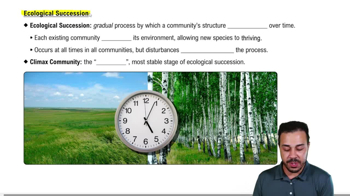
Ecological succession is the process by which ecosystems change and develop over time. It involves a series of stages where different communities of organisms replace one another in a specific area, leading to a more stable ecosystem. This process can be primary, starting from bare rock, or secondary, occurring in areas where a disturbance has cleared out existing vegetation.
Pioneer species are the first organisms to colonize previously disrupted or damaged ecosystems. They play a crucial role in ecological succession by preparing the environment for subsequent species. For example, lichens and mosses can grow on bare rock, breaking it down into soil, which allows other plants to establish themselves.
A climax community is a stable and mature ecological community that has reached the final stage of succession. It is characterized by a diverse array of species and a balanced ecosystem that can sustain itself over time. The composition of a climax community can vary depending on the climate and environmental conditions of the area.