Giraffes live throughout large regions of Africa. Historically, only one species of giraffe has been recognized, but many scientists argue that giraffe populations actually represent four distinct species. What piece of evidence would best determine whether different giraffe populations should be considered different species according to the biological species concept?
Table of contents
- 1. Introduction to Biology2h 43m
- 2. Chemistry3h 37m
- 3. Water1h 30m
- 4. Biomolecules2h 30m
- 5. Cell Components2h 23m
- 6. The Membrane2h 30m
- 7. Energy and Metabolism2h 0m
- 8. Respiration2h 40m
- 9. Photosynthesis2h 55m
- 10. Cell Signaling59m
- 11. Cell Division2h 47m
- 12. Meiosis2h 0m
- 13. Mendelian Genetics4h 44m
- Introduction to Mendel's Experiments7m
- Genotype vs. Phenotype17m
- Punnett Squares13m
- Mendel's Experiments26m
- Mendel's Laws18m
- Monohybrid Crosses19m
- Test Crosses14m
- Dihybrid Crosses20m
- Punnett Square Probability26m
- Incomplete Dominance vs. Codominance20m
- Epistasis7m
- Non-Mendelian Genetics12m
- Pedigrees6m
- Autosomal Inheritance21m
- Sex-Linked Inheritance43m
- X-Inactivation9m
- 14. DNA Synthesis2h 27m
- 15. Gene Expression3h 20m
- 16. Regulation of Expression3h 31m
- Introduction to Regulation of Gene Expression13m
- Prokaryotic Gene Regulation via Operons27m
- The Lac Operon21m
- Glucose's Impact on Lac Operon25m
- The Trp Operon20m
- Review of the Lac Operon & Trp Operon11m
- Introduction to Eukaryotic Gene Regulation9m
- Eukaryotic Chromatin Modifications16m
- Eukaryotic Transcriptional Control22m
- Eukaryotic Post-Transcriptional Regulation28m
- Eukaryotic Post-Translational Regulation13m
- 17. Viruses37m
- 18. Biotechnology2h 58m
- 19. Genomics17m
- 20. Development1h 5m
- 21. Evolution3h 1m
- 22. Evolution of Populations3h 53m
- 23. Speciation1h 39m
- 24. History of Life on Earth2h 6m
- 25. Phylogeny2h 31m
- 26. Prokaryotes4h 57m
- 27. Protists1h 12m
- 28. Plants1h 22m
- 29. Fungi36m
- 30. Overview of Animals34m
- 31. Invertebrates56m
- 32. Vertebrates50m
- 33. Plant Anatomy1h 3m
- 34. Vascular Plant Transport1h 2m
- 35. Soil37m
- 36. Plant Reproduction47m
- 37. Plant Sensation and Response1h 9m
- 38. Animal Form and Function1h 19m
- 39. Digestive System1h 10m
- 40. Circulatory System1h 49m
- 41. Immune System1h 12m
- 42. Osmoregulation and Excretion50m
- 43. Endocrine System1h 4m
- 44. Animal Reproduction1h 2m
- 45. Nervous System1h 55m
- 46. Sensory Systems46m
- 47. Muscle Systems23m
- 48. Ecology3h 11m
- Introduction to Ecology20m
- Biogeography14m
- Earth's Climate Patterns50m
- Introduction to Terrestrial Biomes10m
- Terrestrial Biomes: Near Equator13m
- Terrestrial Biomes: Temperate Regions10m
- Terrestrial Biomes: Northern Regions15m
- Introduction to Aquatic Biomes27m
- Freshwater Aquatic Biomes14m
- Marine Aquatic Biomes13m
- 49. Animal Behavior28m
- 50. Population Ecology3h 41m
- Introduction to Population Ecology28m
- Population Sampling Methods23m
- Life History12m
- Population Demography17m
- Factors Limiting Population Growth14m
- Introduction to Population Growth Models22m
- Linear Population Growth6m
- Exponential Population Growth29m
- Logistic Population Growth32m
- r/K Selection10m
- The Human Population22m
- 51. Community Ecology2h 46m
- Introduction to Community Ecology2m
- Introduction to Community Interactions9m
- Community Interactions: Competition (-/-)38m
- Community Interactions: Exploitation (+/-)23m
- Community Interactions: Mutualism (+/+) & Commensalism (+/0)9m
- Community Structure35m
- Community Dynamics26m
- Geographic Impact on Communities21m
- 52. Ecosystems2h 36m
- 53. Conservation Biology24m
23. Speciation
The Biological Species Concept
Multiple Choice
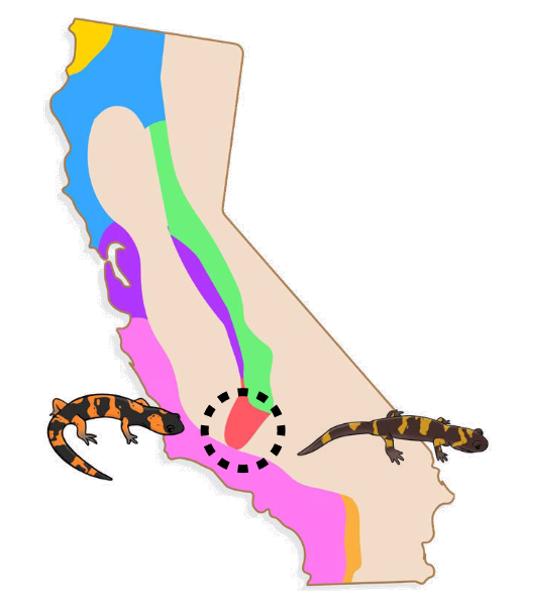
“Ring species” are species that are distributed across a habitat in a ring-like distribution. Every population is able to breed with neighboring populations, but where the ring closes, the populations at the two “ends” do not interbreed. One example of a ring species is Ensatina escholtzii, a species of salamander in California. The species began as a single population in the North, and spread South on either side of the California Central Valley. Each color on the map shows the distribution of different named population of E. escholtzii. Hybrids created by interbreeding of the populations marked with the circle are sterile. If hybrid sterility is present, why do you think these populations are still considered the same species?

A
To be considered separate species there must be pre- and postzygotic barriers.
B
Because each population interbreeds with its neighbor, gene flow is possible throughout the entire species.
C
This is a postzygotic barrier; prezygotic barriers are necessary for speciation.
D
To become distinct species the populations would need to be geographically isolated.
0 Comments
Verified step by step guidance1
Step 1: Understand the concept of a ring species. A ring species consists of populations distributed in a ring-like pattern where neighboring populations can interbreed, but populations at the ends of the ring cannot interbreed successfully.
Step 2: Observe the map showing the distribution of Ensatina escholtzii populations around the California Central Valley. Each color represents a different population, and the populations at the ends of the ring (marked by the dashed circle) produce sterile hybrids.
Step 3: Recognize that hybrid sterility is a postzygotic reproductive barrier, which occurs after fertilization and affects the viability or fertility of offspring.
Step 4: Note that despite the postzygotic barrier at the ends of the ring, gene flow occurs between neighboring populations throughout the ring because they can interbreed successfully. This continuous gene flow connects the populations genetically.
Step 5: Conclude that because gene flow is maintained throughout the ring and there are no prezygotic barriers (which prevent mating or fertilization), the populations are considered a single species rather than separate species.
Related Videos
Related Practice
Multiple Choice
1751
views
9
rank

