Skin color in humans is at least partially hereditary; dark-skinned parents tend to have dark-skinned children. But humans come in a range of skin tones. Which extension of Mendel's model accounts for the hereditary variation in human skin color?
Verified step by step guidance
1
Understand that Mendel's basic model of inheritance involves simple dominant and recessive traits, which doesn't fully explain the continuous variation seen in traits like human skin color.
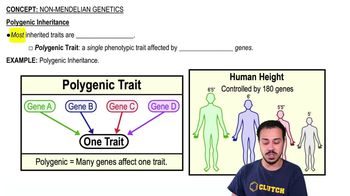
Recognize that human skin color is not determined by a single gene, but rather by multiple genes contributing to the final phenotype, a concept known as polygenic inheritance.
Learn that each gene involved in this polygenic system can have multiple alleles, and the cumulative effect of these alleles results in the wide range of human skin colors.
Consider the influence of environmental factors such as sunlight exposure, which can also affect melanin production in the skin, adding another layer of complexity to the genetic determination of skin color.
Explore how the interaction between multiple genes and environmental factors fits into an extension of Mendel’s model known as quantitative trait locus (QTL) analysis, which helps in understanding how multiple genetic and environmental factors influence complex traits like skin color.
Verified video answer for a similar problem:
This video solution was recommended by our tutors as helpful for the problem above
Video duration:
1m
Play a video:
Was this helpful?
Key Concepts
Here are the essential concepts you must grasp in order to answer the question correctly.
Mendelian Genetics
Mendelian genetics is the study of how traits are inherited through generations, based on the principles established by Gregor Mendel. It focuses on discrete traits controlled by single genes with dominant and recessive alleles. However, this model does not fully explain complex traits, such as skin color, which are influenced by multiple genes.
Polygenic inheritance refers to the phenomenon where multiple genes contribute to a single trait, resulting in a continuous range of phenotypes. In the case of human skin color, several genes interact to produce various shades, leading to the observed diversity. This model explains why offspring can exhibit a range of skin tones, even when parents have similar complexions.
Environmental factors can significantly influence the expression of genetic traits, a concept known as phenotypic plasticity. For skin color, factors such as sun exposure, diet, and overall health can affect melanin production, leading to variations in skin tone. This interaction between genetics and environment is crucial for understanding the full spectrum of human skin color.


 1:32 minutes
 Verified step by step guidance
 04:26
04:26