
What are the defining characteristics of a condensation reaction? a. Two monomers are covalently bonded together and a water molecule is produced. b. Two monomers are covalently bonded together and a water molecule is used up. c. A polymer is broken down into monomers and a water molecule is produced. d. A polymer is broken down into monomers and a water molecule is used up.
Verified step by step guidance
1
Step 1: Understand the concept of a condensation reaction. A condensation reaction, also known as a dehydration synthesis, is a chemical process where two molecules (often monomers) are covalently bonded together, and a water molecule (H₂O) is released as a byproduct.
Step 2: Analyze the options provided in the question. Look for the option that describes the bonding of two monomers and the production of a water molecule, as this aligns with the definition of a condensation reaction.
Step 3: Eliminate options that describe the opposite process, which is hydrolysis. Hydrolysis involves breaking down polymers into monomers and requires the addition of a water molecule, not the release of one.
Step 4: Focus on the correct description of a condensation reaction. The key characteristics are the formation of a covalent bond between two monomers and the release of a water molecule during the process.
Step 5: Select the option that matches the defining characteristics of a condensation reaction: 'Two monomers are covalently bonded together and a water molecule is produced.'
Verified video answer for a similar problem:
This video solution was recommended by our tutors as helpful for the problem above
Video duration:
2m
Play a video:
Was this helpful?
Key Concepts
Here are the essential concepts you must grasp in order to answer the question correctly.
Condensation Reaction
A condensation reaction, also known as a dehydration synthesis, is a chemical process where two molecules combine to form a larger molecule, releasing a small molecule, typically water, as a byproduct. This reaction is fundamental in the formation of polymers from monomers, such as in the synthesis of proteins from amino acids or carbohydrates from simple sugars.
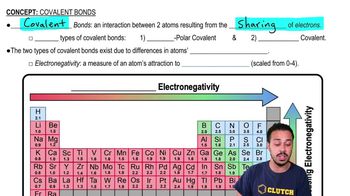
Covalent bonding involves the sharing of electron pairs between atoms, which allows for the formation of stable molecules. In the context of condensation reactions, covalent bonds are formed between monomers, resulting in the creation of larger macromolecules. This type of bonding is crucial for the structural integrity and function of biological macromolecules.
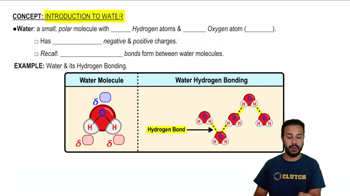
In condensation reactions, water is produced as a byproduct when two monomers are joined together. This occurs because a hydroxyl group (–OH) from one monomer and a hydrogen atom (–H) from another monomer combine to form water (H2O). Understanding the role of water in these reactions is essential for grasping how biological macromolecules are synthesized and how they function in living organisms.