Pearson+ LogoPearson+ Logo
Ch. 44 - Animal Sensory Systems
Freeman - Biological Science 7th Edition
Freeman7th EditionBiological ScienceISBN: 9783584863285Not the one you use?Change textbook
Chapter 44, Problem 5

Considering that sounds and odors both trigger changes in the patterns of action potentials in sensory neurons, how does the brain perceive which sense is which when the action potentials reach the brain?
a. The action potentials stimulated by sounds are different in size and shape from those stimulated by odors.
b. The axons from different sensory neurons go to different areas of the brain.
c. Mechanoreception is not consciously perceived by the brain, whereas chemoreception is.
d. Chemoreception is not consciously perceived by the brain, whereas mechanoreception is.

Verified step by step guidance
1
Understand that sensory neurons are responsible for transmitting information from sensory receptors to the brain through action potentials.
Recognize that action potentials themselves are uniform in size and shape, regardless of the type of stimulus (sound or odor). This rules out option a.
Learn that different types of sensory neurons are connected to specific areas of the brain. This means that the brain can differentiate between senses based on the destination of the axons. This supports option b.
Consider the definitions of mechanoreception and chemoreception: mechanoreception involves the detection of mechanical stimuli (such as sound), while chemoreception involves the detection of chemical stimuli (such as odors).
Evaluate options c and d: both mechanoreception and chemoreception can be consciously perceived by the brain, so neither option c nor d accurately describes the differentiation process.

Verified video answer for a similar problem:

This video solution was recommended by our tutors as helpful for the problem above.
Video duration:
3m
Was this helpful?

Key Concepts

Here are the essential concepts you must grasp in order to answer the question correctly.

Action Potentials

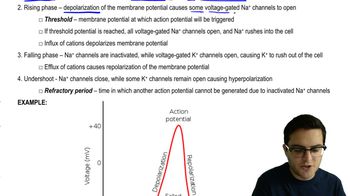
Action potentials are electrical impulses that neurons use to communicate. They are generated when a neuron receives a stimulus, leading to a rapid change in voltage across the cell membrane. This change propagates along the neuron, allowing signals to be transmitted over long distances within the nervous system.
Recommended video:
Guided course
09:55
Action Potential

Sensory Neurons

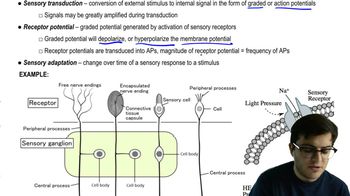
Sensory neurons are specialized cells that detect external stimuli, such as sounds and odors, and convert them into electrical signals (action potentials). These neurons are responsible for transmitting sensory information from the peripheral nervous system to the central nervous system, where it is processed and interpreted.
Recommended video:
Guided course
06:25
Sensory Systems

Brain's Sensory Processing

The brain processes sensory information by routing action potentials from different sensory neurons to specific areas dedicated to each sense. This organization allows the brain to distinguish between different types of stimuli, such as sounds and odors, based on the origin of the signals and the pathways they travel within the brain.
Recommended video:
Guided course
06:25
Sensory Systems