
Pearson+ LogoPearson+ Logo
Ch.3 - Protein Structure and Function
Freeman - Biological Science 7th Edition
Freeman7th EditionBiological ScienceISBN: 9783584863285Not the one you use?Change textbook
Chapter 3, Problem 8

Predict the effect on protein function if each polypeptide adopted only a single, inflexible shape based on its primary structure.

Verified step by step guidance
1
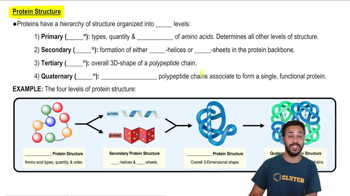
Step 1: Understand the basics of protein structure. Proteins are made up of polypeptides, which are chains of amino acids. The sequence of these amino acids is known as the primary structure of the protein. This primary structure determines the protein's secondary and tertiary structures, which are the shapes the polypeptide chain folds into.
Step 2: Consider the role of protein flexibility. Proteins are not static structures; they can change shape in response to changes in their environment or the needs of the cell. This flexibility allows proteins to perform a wide variety of functions, from acting as enzymes to serving as structural components of cells.
Step 3: Predict the effect of inflexibility. If each polypeptide could only adopt a single, inflexible shape based on its primary structure, it would limit the protein's ability to respond to changes in its environment or the needs of the cell. This could potentially impair the protein's function.
Step 4: Consider specific examples. For instance, enzymes often change shape to bind to their substrates. If an enzyme were inflexible, it might not be able to bind to its substrate effectively, reducing its catalytic activity.
Step 5: Summarize the prediction. In conclusion, if each polypeptide adopted only a single, inflexible shape based on its primary structure, it would likely reduce the functionality of proteins, potentially impairing many cellular processes.

Verified video answer for a similar problem:

This video solution was recommended by our tutors as helpful for the problem above.
Video duration:
2m
Was this helpful?

Key Concepts

Here are the essential concepts you must grasp in order to answer the question correctly.

Primary Structure of Proteins

The primary structure of a protein refers to its unique sequence of amino acids, which are linked by peptide bonds. This sequence determines the protein's overall structure and function, as the specific order of amino acids influences how the protein will fold into its secondary and tertiary structures.
Recommended video:
Guided course
08:02
Protein Structure

Protein Folding

Protein folding is the process by which a polypeptide chain acquires its functional three-dimensional shape. Proper folding is crucial for protein function, as misfolded proteins can lead to loss of activity or diseases. The folding process is influenced by various interactions, including hydrogen bonds, ionic bonds, and hydrophobic interactions.
Recommended video:
Guided course
08:02
Protein Structure

Protein Function and Flexibility

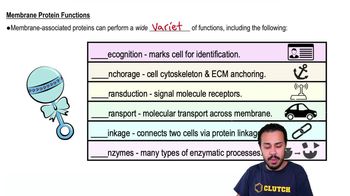
The function of a protein is closely tied to its structure, which often requires flexibility to interact with other molecules. If a polypeptide were to adopt a single, inflexible shape, it would likely be unable to perform its biological functions, such as binding to substrates or undergoing conformational changes necessary for activity.
Recommended video:
Guided course
03:54
Membrane Protein Functions