Why was it important to include a positive control and a negative control in the PCR analysis?
Verified step by step guidance
1
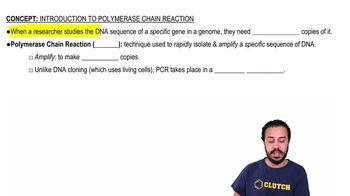
Step 1: Understand the concept of PCR: PCR (Polymerase Chain Reaction) is a technique used in molecular biology to amplify a single or a few copies of a piece of DNA across several orders of magnitude, generating thousands to millions of copies of a particular DNA sequence.
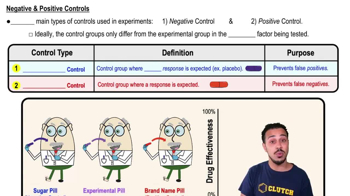
Step 2: Understand the concept of controls in experiments: Controls are used in scientific experiments to ensure that the results are due to the variable being tested and not some other factor. A positive control is a procedure that is very similar to the actual experimental test but is known from previous experience to give a positive result. A negative control is a control group in an experiment that uses a treatment that isn't expected to produce results.
Step 3: Importance of positive control in PCR: A positive control in a PCR experiment is a DNA sample that is known to contain the sequence of interest and is expected to produce a positive result. This control is important because it confirms that the PCR reagents and conditions are working properly to amplify the DNA. If the positive control fails to produce a result, it indicates a problem with the PCR setup.
Step 4: Importance of negative control in PCR: A negative control in a PCR experiment is a sample that does not contain the DNA sequence of interest and is not expected to produce a result. This control is important because it checks for contamination in the reagents or equipment. If the negative control produces a result, it indicates contamination.
Step 5: Conclusion: Therefore, both positive and negative controls are crucial in PCR analysis. They ensure the validity of the results by confirming that the PCR setup is working correctly (positive control) and that there is no contamination (negative control).
Verified video answer for a similar problem:
This video solution was recommended by our tutors as helpful for the problem above
Video duration:
2m
Play a video:
Was this helpful?
Key Concepts
Here are the essential concepts you must grasp in order to answer the question correctly.
Positive Control
A positive control in PCR is a sample known to produce a positive result, ensuring that the PCR process is functioning correctly. It confirms that the reagents and conditions used in the experiment are capable of amplifying DNA when present. This helps validate the experimental setup and provides a benchmark against which the test samples can be compared.
A negative control in PCR is a sample that lacks the target DNA, which should not yield any amplification. This control is crucial for identifying contamination or non-specific amplification in the experiment. By ensuring that the negative control does not produce a signal, researchers can confidently attribute any positive results to the presence of the target DNA in the experimental samples.
PCR is a molecular biology technique used to amplify specific DNA sequences, making millions of copies from a small initial sample. It involves repeated cycles of denaturation, annealing, and extension, facilitated by DNA polymerase. Understanding PCR is essential for interpreting results, as the accuracy and reliability of the amplification depend on the proper use of controls to validate the process.


 2: minutes
 Verified step by step guidance
 07:42
07:42