A man with type A blood marries a woman with type B blood. Their child has type O blood. What are the genotypes of these three individuals? What genotypes, and in what frequencies, would you expect in future offspring from this marriage?
Verified step by step guidance
1
Step 1: Identify the blood types and their corresponding genotypes. Type A blood can be AA or AO, type B blood can be BB or BO, and type O blood is always OO.
Step 2: Determine the parents' genotypes based on the child's blood type. Since the child has type O blood (OO), each parent must have contributed an O allele. Therefore, the man's genotype must be AO and the woman's genotype must be BO.
Step 3: Use a Punnett square to predict the genotypes of future offspring. The Punnett square for this cross would look like this:
| | A | O |
|---|---|---|
| B | AB | BO |
| O | AO | OO |
Step 4: Determine the frequencies of the genotypes. According to the Punnett square, there is a 25% chance for each genotype (AB, BO, AO, OO) in future offspring.
Step 5: Translate the genotypes into blood types. The possible blood types for future offspring are A (AO), B (BO), AB (AB), and O (OO), each with a 25% chance.
Verified video answer for a similar problem:
This video solution was recommended by our tutors as helpful for the problem above
Video duration:
1m
Play a video:
Was this helpful?
Key Concepts
Here are the essential concepts you must grasp in order to answer the question correctly.
Blood Type Genetics
Blood types are determined by the ABO gene, which has three alleles: A, B, and O. A and B are co-dominant, meaning that if both are present, both traits are expressed, while O is recessive. Therefore, individuals with type A blood can have genotypes AA or AO, and those with type B can have BB or BO. Type O blood results from the genotype OO.
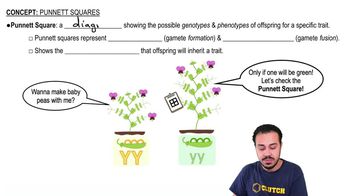
A Punnett square is a tool used in genetics to predict the genotypes of offspring from parental genotypes. By arranging the alleles of each parent along the axes of a grid, one can visualize the possible combinations of alleles in the offspring. This method helps in determining the probabilities of each genotype occurring in future generations.
Mendelian inheritance refers to the patterns of inheritance first described by Gregor Mendel, which include the principles of segregation and independent assortment. These principles explain how alleles segregate during gamete formation and how traits are inherited independently of one another. Understanding these principles is crucial for predicting the genetic outcomes of offspring in a given cross.