The mountain gorilla, spotted owl, giant panda, snow leopard, and grizzly bear are all endangered by human encroachment on their environments. Another thing these animals have in common is their K-selected life history traits. Why might they be more easily endangered than animals with r-selected life history traits? What general type of survivorship curve would you expect these species to exhibit? Explain your answer.
Verified step by step guidance
1
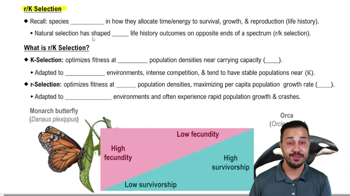
Understand the difference between K-selected and r-selected life history traits. K-selected species, like the mountain gorilla and giant panda, typically have fewer offspring, invest more in parental care, and have a longer lifespan. In contrast, r-selected species produce many offspring, provide little parental care, and have a shorter lifespan.
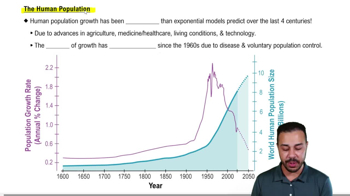
Analyze why K-selected species might be more vulnerable to endangerment. Due to their low reproductive rates and longer generation times, K-selected species cannot quickly recover from population declines. This makes them particularly susceptible to habitat destruction and other environmental changes caused by human activities.
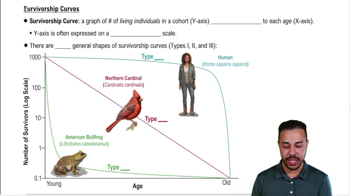
Identify the type of survivorship curve associated with K-selected species. K-selected species generally exhibit a Type I survivorship curve, characterized by high survival rates of the young and middle-aged individuals, with most mortality occurring among older individuals.
Explain the implications of a Type I survivorship curve for conservation efforts. Since most individuals in K-selected species survive to an older age, the loss of any individuals due to human encroachment can significantly impact the population's ability to sustain itself.
Discuss the importance of habitat preservation and other conservation strategies for K-selected species. Protecting the environments where these species live is crucial for their survival, as their specific life history traits make them less adaptable to rapidly changing conditions or fragmented habitats.
Verified video answer for a similar problem:
This video solution was recommended by our tutors as helpful for the problem above
Video duration:
3m
Play a video:
Was this helpful?
Key Concepts
Here are the essential concepts you must grasp in order to answer the question correctly.
K-selected vs. r-selected species
K-selected species, like the mountain gorilla and giant panda, invest heavily in a few offspring, ensuring their survival through parental care and longer gestation periods. In contrast, r-selected species produce many offspring with less investment in each, allowing for rapid population growth in unstable environments. This difference makes K-selected species more vulnerable to extinction when their habitats are threatened, as they cannot quickly rebound from population declines.
Survivorship curves graphically represent the number of individuals surviving at each age for a given species. K-selected species typically exhibit a Type I survivorship curve, characterized by high survival rates during early and middle life, followed by a steep decline in older age. This pattern reflects their reproductive strategy, where individuals survive longer due to parental investment, making them more susceptible to threats that impact their habitat.
Human encroachment refers to the expansion of human activities into natural habitats, leading to habitat loss and fragmentation. This process poses significant threats to K-selected species, as their specialized habitats are often altered or destroyed, reducing their chances of survival. The loss of habitat not only decreases available resources but also increases competition and vulnerability to predators, further endangering these species.