Adaptive radiations may be promoted by all of the following except one. Which one? a. Mass extinctions that result in vacant ecological niches b. Colonization of an isolated region with few competitors c. A gradual change in climate d. A novel adaptation
Verified step by step guidance
1
Understand the concept of adaptive radiation: Adaptive radiation refers to the rapid evolution of diverse species from a common ancestor when new ecological niches become available. This often occurs when there is reduced competition or new opportunities for survival and reproduction.
Analyze option (a): Mass extinctions can lead to vacant ecological niches, providing opportunities for surviving species to diversify and adapt to new roles in the ecosystem. This promotes adaptive radiation.
Analyze option (b): Colonization of an isolated region with few competitors allows species to exploit available resources and adapt to different ecological niches, leading to adaptive radiation.
Analyze option (c): A gradual change in climate does not typically create sudden opportunities for adaptive radiation. Gradual changes are less likely to result in the rapid diversification of species compared to abrupt events like mass extinctions or colonization.
Analyze option (d): A novel adaptation, such as the evolution of wings or photosynthesis, can open up new ecological niches and promote adaptive radiation by allowing species to exploit previously inaccessible resources.
Verified video answer for a similar problem:
This video solution was recommended by our tutors as helpful for the problem above
Video duration:
2m
Play a video:
Was this helpful?
Key Concepts
Here are the essential concepts you must grasp in order to answer the question correctly.
Adaptive Radiation
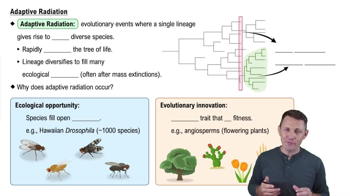
Adaptive radiation is an evolutionary process where organisms diversify rapidly into a variety of forms to adapt to different environments. This typically occurs when a species colonizes a new habitat with diverse ecological niches, leading to the emergence of new species that are adapted to specific conditions.
An ecological niche refers to the role and position a species has in its environment, including its habitat, resource use, and interactions with other organisms. Vacant ecological niches, often created by events like mass extinctions, provide opportunities for adaptive radiation as new species evolve to fill these roles.
Novel adaptations are new traits or behaviors that evolve in a species, allowing it to exploit different resources or survive in changing environments. These adaptations can drive adaptive radiation by enabling species to occupy new niches or respond to environmental pressures, thus promoting biodiversity.