The graph below shows the results of an experiment in which mice learned to run through a maze. State the hypothesis and prediction that you think this experiment tested.
Verified step by step guidance
1
Examine the graph carefully. The graph shows the average time (in minutes) it took mice to complete a maze over six days under two conditions: 'No reward' (red line) and 'Food reward' (blue line). Note that the time decreases for both groups, but the decrease is more pronounced for the 'Food reward' group.
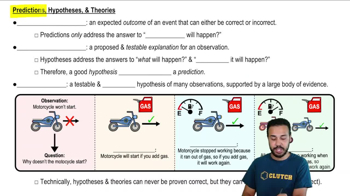
Identify the hypothesis. A possible hypothesis for this experiment could be: 'Providing a food reward will improve the learning ability of mice, leading to faster maze completion times compared to mice that receive no reward.'
Formulate the prediction based on the hypothesis. The prediction might be: 'If mice are given a food reward after completing the maze, they will learn to complete the maze faster over time compared to mice that receive no reward.'
Relate the data to the hypothesis and prediction. The graph supports the hypothesis and prediction, as the 'Food reward' group shows a steeper decline in average maze completion time compared to the 'No reward' group, indicating faster learning.
Conclude that the experiment likely tested the effect of rewards (specifically food rewards) on the learning and performance of mice in completing a maze.
Verified video answer for a similar problem:
This video solution was recommended by our tutors as helpful for the problem above
Video duration:
2m
Play a video:
Was this helpful?
Key Concepts
Here are the essential concepts you must grasp in order to answer the question correctly.
Hypothesis
A hypothesis is a testable statement that predicts the relationship between variables in an experiment. In this context, it could be that providing a food reward will enhance the learning speed of mice in a maze compared to those without a reward.
A learning curve represents the rate at which an individual acquires knowledge or skills over time. The graph illustrates how the average time to complete the maze decreases for mice receiving food rewards, indicating improved learning compared to those without rewards.
Experimental control refers to the practice of keeping certain variables constant to isolate the effects of the independent variable. In this experiment, the control group (mice without food rewards) allows for a comparison to assess the impact of the food reward on maze completion times.