Why is it important that the small intestine has a much greater surface area than the stomach or esophagus?
Verified step by step guidance
1
The small intestine is the primary site of nutrient absorption in the digestive system. A greater surface area allows for more efficient absorption of nutrients.
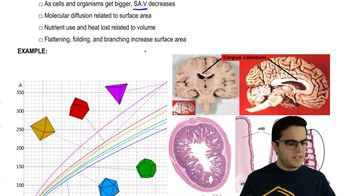
The inner lining of the small intestine is covered with tiny, finger-like projections called villi, and each villus has even smaller hair-like structures called microvilli. These structures increase the surface area significantly.
With a larger surface area, there are more locations for digestive enzymes to act, which helps in the breakdown of complex molecules into simpler ones that can be absorbed.
The increased surface area also allows for a greater number of transport channels and carrier proteins, which facilitate the movement of nutrients from the intestine into the bloodstream.
Overall, the extensive surface area of the small intestine ensures that the body can absorb sufficient nutrients from the food we eat, which is essential for energy production and overall health.
Verified video answer for a similar problem:
This video solution was recommended by our tutors as helpful for the problem above
Video duration:
2m
Play a video:
Was this helpful?
Key Concepts
Here are the essential concepts you must grasp in order to answer the question correctly.
Surface Area to Volume Ratio
The surface area to volume ratio is a critical concept in biology that describes how the surface area of an organism or organ relates to its volume. A higher surface area allows for more efficient absorption and exchange of materials, which is essential for processes like nutrient uptake in the digestive system.
Absorption is the process by which nutrients from digested food are taken up into the bloodstream. The small intestine is specifically adapted for this function, featuring villi and microvilli that increase its surface area, allowing for maximum nutrient absorption compared to the stomach and esophagus, which have different roles in digestion.
Different parts of the digestive system have specialized functions. The stomach primarily breaks down food through mechanical and chemical means, while the esophagus serves as a conduit. In contrast, the small intestine is specialized for nutrient absorption, necessitating a larger surface area to optimize this critical function.