If you were given a solution that has a pH of 8.5, what would be its concentration of protons? What is the difference in proton concentration between this solution and one that has a pH of 7?
Verified step by step guidance
1
Understand the relationship between pH and proton concentration: pH is defined as the negative logarithm (base 10) of the hydrogen ion concentration. Mathematically, it is represented as pH = -log10[H+], where [H+] is the concentration of hydrogen ions in moles per liter.
Calculate the proton concentration for the solution with pH 8.5: Use the formula [H+] = 10^(-pH). Substituting the given pH, [H+] = 10^(-8.5) = 3.16 x 10^-9 M.
Calculate the proton concentration for the solution with pH 7: Similarly, use the formula [H+] = 10^(-pH). For pH 7, [H+] = 10^(-7) = 1 x 10^-7 M.
Determine the difference in proton concentration between the two solutions: Subtract the proton concentration of the pH 8.5 solution from that of the pH 7 solution. Difference = 1 x 10^-7 M - 3.16 x 10^-9 M = 9.684 x 10^-8 M.
Interpret the result: The solution with pH 7 has a higher proton concentration compared to the solution with pH 8.5. The difference in proton concentration is 9.684 x 10^-8 M, indicating that the pH 7 solution is more acidic.
Verified video answer for a similar problem:
This video solution was recommended by our tutors as helpful for the problem above
Video duration:
44s
Play a video:
Was this helpful?
Key Concepts
Here are the essential concepts you must grasp in order to answer the question correctly.
pH Scale
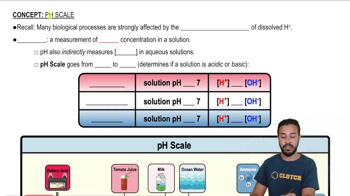
The pH scale measures the acidity or basicity of a solution, ranging from 0 to 14. A pH of 7 is considered neutral, values below 7 indicate acidity, and values above 7 indicate alkalinity. Each unit change in pH represents a tenfold change in hydrogen ion concentration, making it a logarithmic scale.
Proton concentration in a solution is often expressed in terms of molarity, specifically as [H+]. The relationship between pH and proton concentration is given by the formula [H+] = 10^(-pH). Therefore, a higher pH corresponds to a lower concentration of protons, while a lower pH indicates a higher concentration.
To find the difference in proton concentration between two solutions with different pH values, one can calculate the [H+] for each pH using the formula mentioned above. For example, a solution with pH 8.5 has a lower proton concentration than one with pH 7, and the difference can be quantified by subtracting the two concentrations.