Plants require the smallest amount of which of the following nutrients? a. Oxygen b. Phosphorus c. Carbon d. Iron
Verified step by step guidance
1
Step 1: Understand the context of the question. Plants require various nutrients for growth and development, but the quantity needed for each nutrient varies. Some nutrients are required in large amounts (macronutrients), while others are needed in trace amounts (micronutrients).
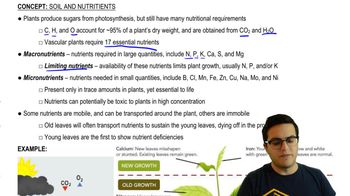
Step 2: Review the options provided. Oxygen, phosphorus, and carbon are macronutrients, meaning plants need them in relatively large quantities for processes like photosynthesis, energy transfer, and structural development. Iron, on the other hand, is a micronutrient, required in much smaller amounts.
Step 3: Recall the role of iron in plants. Iron is essential for the synthesis of chlorophyll and is involved in various enzymatic processes, but plants only need trace amounts of it compared to macronutrients.
Step 4: Compare the roles and quantities of the nutrients listed. Oxygen and carbon are integral to photosynthesis and respiration, and phosphorus is crucial for energy transfer (ATP). These are required in larger amounts than iron.
Step 5: Conclude that among the options provided, iron is the nutrient required in the smallest amount by plants, as it is a micronutrient.
Verified video answer for a similar problem:
This video solution was recommended by our tutors as helpful for the problem above
Video duration:
1m
Play a video:
Was this helpful?
Key Concepts
Here are the essential concepts you must grasp in order to answer the question correctly.
Essential Nutrients for Plants
Plants require a variety of nutrients to grow, which are categorized into macronutrients and micronutrients. Macronutrients, such as nitrogen, phosphorus, and potassium, are needed in larger quantities, while micronutrients, like iron, are required in smaller amounts but are still vital for plant health.
Iron is a micronutrient essential for plants, playing a crucial role in chlorophyll synthesis and various enzymatic processes. Although plants need iron in smaller amounts compared to macronutrients, its deficiency can lead to chlorosis, affecting overall plant vitality and growth.
Carbon dioxide is a critical component of photosynthesis, the process by which plants convert light energy into chemical energy. While plants absorb carbon dioxide from the atmosphere in significant amounts, it is not classified as a nutrient in the same way as minerals, making it distinct from the other options listed.


 1:32 minutes
 Verified step by step guidance
 03:25
03:25