What does it mean to say that a hypha is dikaryotic? a. Two nuclei fuse during sexual reproduction to form a zygote. b. Two independent nuclei, derived from different individuals, are present in each cell. c. The nucleus is diploid or polyploid — not haploid. d. It is extremely highly branched, which increases its surface area and thus absorptive capacity.
Verified step by step guidance
1
Understand the term 'dikaryotic': In biology, particularly in the study of fungi, 'dikaryotic' refers to a stage in the life cycle where cells contain two distinct nuclei.
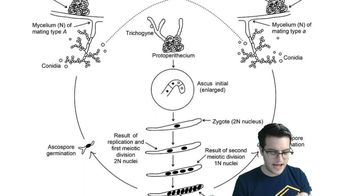
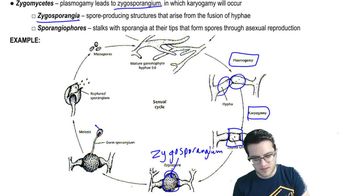
Identify the context: Dikaryotic cells are typically found in fungi during sexual reproduction, specifically after plasmogamy (fusion of cytoplasm) but before karyogamy (fusion of nuclei).
Analyze the options: Consider each option provided in the problem and relate them to the definition of 'dikaryotic'.
Option b: 'Two independent nuclei, derived from different individuals, are present in each cell' aligns with the definition of dikaryotic, as it describes the presence of two separate nuclei within a single cell.
Conclude: Based on the analysis, option b correctly describes what it means for a hypha to be dikaryotic, as it involves two independent nuclei from different individuals coexisting in the same cell.
Verified video answer for a similar problem:
This video solution was recommended by our tutors as helpful for the problem above
Video duration:
1m
Play a video:
Was this helpful?
Key Concepts
Here are the essential concepts you must grasp in order to answer the question correctly.
Hypha
A hypha is a long, branching filamentous structure of a fungus, and is the main mode of vegetative growth. Hyphae collectively form a network called a mycelium, which is crucial for nutrient absorption. Understanding the structure and function of hyphae is essential for comprehending fungal biology and their role in ecosystems.
The term 'dikaryotic' refers to a stage in the fungal life cycle where each cell contains two genetically distinct nuclei. This condition occurs after plasmogamy, the fusion of cytoplasm from two parent mycelia, but before karyogamy, the fusion of nuclei. Dikaryotic cells are characteristic of many fungi, particularly in the phylum Basidiomycota.
Fungal reproduction can be sexual or asexual, involving complex life cycles with various stages. In sexual reproduction, fungi often undergo plasmogamy, dikaryotic stage, karyogamy, and meiosis. Understanding these stages is crucial for identifying how genetic material is exchanged and how fungi adapt to their environments.