What is meant by the term 'chemical equilibrium'? Must amounts of reactants and products be equal at equilibrium?
Verified step by step guidance
1
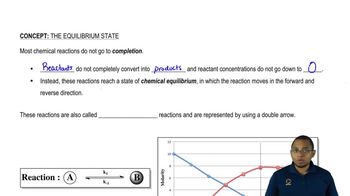
Chemical equilibrium refers to the state in a reversible chemical reaction where the rate of the forward reaction equals the rate of the reverse reaction.
At equilibrium, the concentrations of reactants and products remain constant over time, but they are not necessarily equal.
The equilibrium position is determined by the equilibrium constant, \( K_{eq} \), which is the ratio of the concentrations of products to reactants, each raised to the power of their stoichiometric coefficients.
The equilibrium constant expression for a general reaction \( aA + bB \rightleftharpoons cC + dD \) is given by \( K_{eq} = \frac{[C]^c[D]^d}{[A]^a[B]^b} \).
Thus, at equilibrium, the amounts of reactants and products are determined by \( K_{eq} \), and they do not have to be equal.
Was this helpful?
Key Concepts
Here are the essential concepts you must grasp in order to answer the question correctly.
Chemical Equilibrium
Chemical equilibrium refers to a state in a reversible chemical reaction where the rates of the forward and reverse reactions are equal, resulting in constant concentrations of reactants and products over time. This dynamic balance means that while the reaction continues to occur, there is no net change in the amounts of substances involved.
Equilibrium is dynamic, meaning that even though the concentrations of reactants and products remain constant, the individual molecules are still reacting. This ongoing process allows for the continuous exchange between reactants and products, which is crucial for understanding how systems respond to changes in conditions, such as concentration or temperature.
At equilibrium, the concentrations of reactants and products are not necessarily equal; rather, they are related by the equilibrium constant (K). This constant reflects the ratio of product concentrations to reactant concentrations, each raised to the power of their coefficients in the balanced equation, indicating that different reactions can achieve equilibrium with varying amounts of reactants and products.