Compare the Lewis structures of CH₄ and H₂O Why do these molecules have similar bond angles but different molecular shapes?
Verified step by step guidance
1
Step 1: Draw the Lewis structures for both CH₄ and H₂O.
Step 2: For CH₄, carbon (C) is the central atom with four hydrogen (H) atoms bonded to it. Each C-H bond is a single bond, and carbon has no lone pairs.
Step 3: For H₂O, oxygen (O) is the central atom with two hydrogen (H) atoms bonded to it. Each O-H bond is a single bond, and oxygen has two lone pairs.
Step 4: Determine the electron pair geometry for both molecules. CH₄ has a tetrahedral electron pair geometry, while H₂O has a bent molecular shape due to the two lone pairs on oxygen.
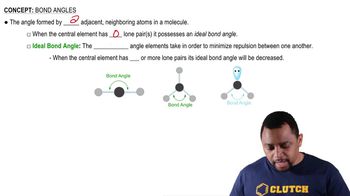
Step 5: Explain that the bond angles in CH₄ are approximately 109.5° due to its tetrahedral shape, while in H₂O, the bond angle is slightly less than 109.5° because the lone pairs on oxygen repel the hydrogen atoms, resulting in a bent shape.
Verified video answer for a similar problem:
This video solution was recommended by our tutors as helpful for the problem above.
Video duration:
11m
Play a video:
0 Comments
Key Concepts
Here are the essential concepts you must grasp in order to answer the question correctly.
Lewis Structures
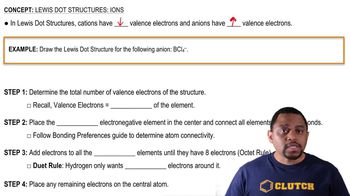
Lewis structures are diagrams that represent the bonding between atoms in a molecule and the lone pairs of electrons that may exist. They use dots to represent valence electrons and lines to indicate bonds. Understanding Lewis structures is essential for visualizing how atoms are arranged and how they interact, which is crucial for analyzing molecular shapes and bond angles.
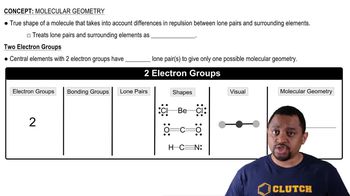
Molecular geometry refers to the three-dimensional arrangement of atoms within a molecule. It is determined by the number of bonding pairs and lone pairs of electrons around the central atom, which influences the shape of the molecule. For example, CH₄ has a tetrahedral geometry due to four bonding pairs, while H₂O has a bent shape due to two bonding pairs and two lone pairs.
Bond angles are the angles formed between adjacent bonds in a molecule, influenced by the repulsion between electron pairs. In CH₄, the bond angles are approximately 109.5° due to its tetrahedral shape, while in H₂O, the bond angle is about 104.5° because the lone pairs repel more strongly than bonding pairs, resulting in a smaller angle. Understanding bond angles helps explain the differences in molecular shapes despite similar electron arrangements.

 11:36 minutes
 Verified step by step guidance
 03:11
03:11