Draw a Lewis structure for the following polyatomic ions: b. Sulfite, SO²⁻₃
Verified step by step guidance
1
Identify the total number of valence electrons in the sulfite ion (SO₃²⁻). Sulfur (S) has 6 valence electrons, each oxygen (O) has 6 valence electrons, and the 2- charge adds 2 more electrons.
Calculate the total number of valence electrons: 1 sulfur (6 electrons) + 3 oxygens (3 x 6 electrons) + 2 extra electrons from the charge = 26 valence electrons.
Place the sulfur atom in the center as it is less electronegative than oxygen, and arrange the three oxygen atoms around it.
Distribute the 26 valence electrons around the atoms, starting by forming single bonds between the sulfur and each oxygen atom. This uses up 6 electrons (2 electrons per bond).
Distribute the remaining electrons to satisfy the octet rule for each atom, starting with the outer oxygen atoms. If necessary, form double bonds to ensure that the central sulfur atom also achieves an octet.
Verified video answer for a similar problem:
This video solution was recommended by our tutors as helpful for the problem above.
Video duration:
5m
Play a video:
0 Comments
Key Concepts
Here are the essential concepts you must grasp in order to answer the question correctly.
Lewis Structures
Lewis structures are diagrams that represent the bonding between atoms in a molecule and the lone pairs of electrons that may exist. They use dots to represent valence electrons and lines to represent bonds between atoms. Understanding how to draw Lewis structures is essential for visualizing molecular geometry and predicting the behavior of molecules in chemical reactions.
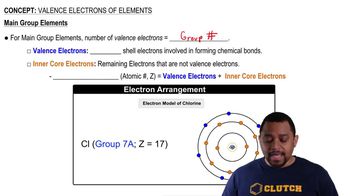
Valence electrons are the electrons in the outermost shell of an atom that are involved in forming bonds with other atoms. The number of valence electrons determines how an atom can bond and interact with other atoms. For polyatomic ions like sulfite, knowing the total number of valence electrons is crucial for accurately constructing the Lewis structure.
Valence Electrons of Elements (Simplified) Concept 1
Polyatomic Ions
Polyatomic ions are charged species composed of two or more atoms covalently bonded together, which collectively carry a charge. In the case of sulfite (SO₃²⁻), it consists of one sulfur atom and three oxygen atoms, with an overall charge of -2. Recognizing the structure and charge of polyatomic ions is important for understanding their reactivity and how they participate in chemical reactions.

 5:10 minutes
 Verified step by step guidance

 03:11
03:11