Many pharmaceuticals are marketed with the designation 'HCl' appended to the name of the drug. What does the 'HCl' mean? What type of reaction would be involved in converting a drug to the HCl form? What are the advantages of this form of the drug?
Verified step by step guidance
1
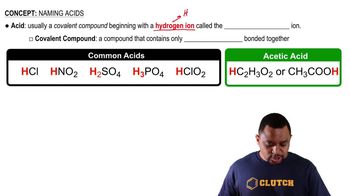
The 'HCl' designation indicates that the drug is in the form of a hydrochloride salt, which is formed by reacting the drug with hydrochloric acid (HCl).
To convert a drug to its hydrochloride form, an acid-base reaction occurs where the drug, typically a weak base, reacts with hydrochloric acid to form the hydrochloride salt.
The general reaction can be represented as: Base (drug) + HCl → Base-HCl (hydrochloride salt).
One advantage of converting a drug to its hydrochloride form is increased solubility in water, which can enhance the drug's absorption in the body.
Another advantage is improved stability and shelf-life of the drug, as the hydrochloride form can be less prone to degradation compared to the free base form.
Was this helpful?
Key Concepts
Here are the essential concepts you must grasp in order to answer the question correctly.
Hydrochloric Acid (HCl)
HCl, or hydrochloric acid, is a strong acid formed when hydrogen chloride gas dissolves in water. In pharmaceuticals, the 'HCl' designation indicates that the drug is in its hydrochloride salt form, which enhances its solubility and stability. This form is often used to improve the drug's absorption in the body, making it more effective.
The conversion of a drug to its HCl form typically involves an acid-base reaction, where the drug (often a base) reacts with hydrochloric acid. This reaction results in the formation of a salt, which can alter the drug's physical properties, such as solubility and stability, thereby improving its pharmacokinetic profile.
Using hydrochloride salts in pharmaceuticals offers several advantages, including increased solubility in water, which facilitates better absorption in the gastrointestinal tract. Additionally, these salts can enhance the stability of the drug, prolong shelf life, and reduce the likelihood of degradation, ultimately leading to improved efficacy and patient compliance.