Identify the group or period number described by each of the following:
a. contains C, N, and O
Verified step by step guidance
1
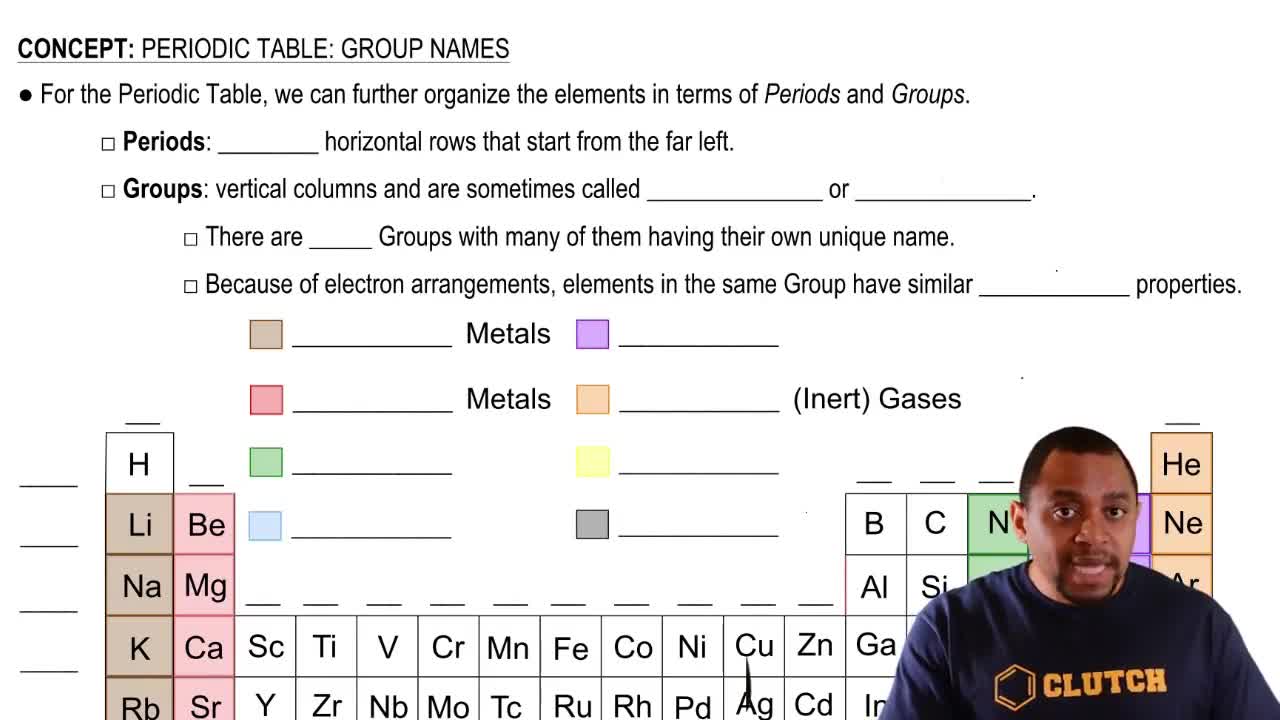
Step 1: Understand the periodic table structure. The periodic table is organized into groups (vertical columns) and periods (horizontal rows).
Step 2: Identify the elements mentioned in the problem: C (Carbon), N (Nitrogen), and O (Oxygen).
Step 3: Locate these elements on the periodic table. Carbon (C) is in group 14, Nitrogen (N) is in group 15, and Oxygen (O) is in group 16.
Step 4: Determine the common feature among these elements. They are all in the same period, which is period 2.
Step 5: Conclude that the elements C, N, and O are all located in period 2 of the periodic table.
Verified video answer for a similar problem:
This video solution was recommended by our tutors as helpful for the problem above.
Video duration:
1m
Play a video:
0 Comments
Key Concepts
Here are the essential concepts you must grasp in order to answer the question correctly.
Periodic Table Groups and Periods
The periodic table is organized into rows called periods and columns called groups. Each group contains elements with similar chemical properties due to their similar valence electron configurations. Periods indicate the number of electron shells an atom has. Understanding this organization helps identify the relationships between elements.
Group 14 of the periodic table includes carbon (C), silicon (Si), germanium (Ge), tin (Sn), lead (Pb), and flerovium (Fl). This group is characterized by having four valence electrons, allowing for diverse bonding capabilities. Carbon, in particular, is essential for organic chemistry and life, while nitrogen (N) and oxygen (O) are found in Group 15 and Group 16, respectively.
Carbon, nitrogen, and oxygen are nonmetals that exhibit distinct chemical properties. Nonmetals typically have high electronegativities and ionization energies, and they tend to gain electrons during chemical reactions. These elements are crucial in forming covalent bonds and are fundamental to biological molecules, such as proteins and nucleic acids.

 1:19 minutes
 Verified step by step guidance
 05:33
05:33