Consider the balanced chemical equation: A2 + 2B2 → 2AB2. A reaction is performed with the initial amounts of A2 and B2 shown in part (a). The amount of product obtained is shown in part (b). Calculate the percent yield.a.
Verified step by step guidance
1
Count the initial number of A2 and B2 molecules from the image. Let's say there are X A2 molecules and Y B2 molecules.
According to the balanced equation A2 + 2B2 → 2AB2, determine the limiting reactant by comparing the mole ratio of A2 to B2. Use the stoichiometry of the reaction to find the theoretical yield of AB2.
Count the number of AB2 molecules formed in the product image. This is the actual yield.
Calculate the theoretical yield of AB2 using the limiting reactant. For every 1 mole of A2, 2 moles of AB2 are produced, and for every 2 moles of B2, 2 moles of AB2 are produced.
Calculate the percent yield using the formula: \( \text{Percent Yield} = \left( \frac{\text{Actual Yield}}{\text{Theoretical Yield}} \right) \times 100 \).
Was this helpful?
Key Concepts
Here are the essential concepts you must grasp in order to answer the question correctly.
Balanced Chemical Equation
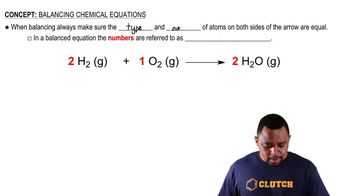
A balanced chemical equation represents a chemical reaction where the number of atoms for each element is the same on both sides of the equation. This ensures the law of conservation of mass is upheld, meaning matter is neither created nor destroyed during the reaction. In the given equation, A2 and B2 react to form AB2, with coefficients indicating the stoichiometric ratios of reactants and products.
Balancing Chemical Equations (Simplified) Concept 1
Percent Yield
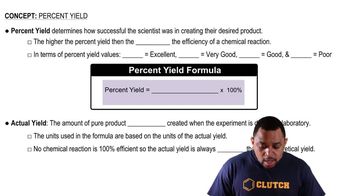
Percent yield is a measure of the efficiency of a chemical reaction, calculated by comparing the actual yield of a product obtained from the reaction to the theoretical yield predicted by stoichiometry. It is expressed as a percentage and is calculated using the formula: (actual yield / theoretical yield) × 100. This concept is crucial for evaluating how well a reaction proceeds under given conditions.
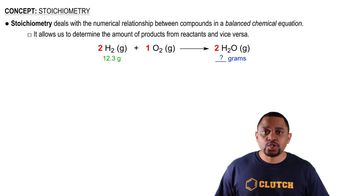
Stoichiometry is the branch of chemistry that deals with the quantitative relationships between the reactants and products in a chemical reaction. It involves using the coefficients from a balanced equation to determine the amounts of substances consumed and produced. Understanding stoichiometry is essential for calculating theoretical yields and determining the limiting reactant in a reaction.