Write the electron configurations of Co, Co^2+, and Co^3+.
Verified step by step guidance
1
Identify the atomic number of cobalt (Co), which is 27, indicating it has 27 electrons in its neutral state.
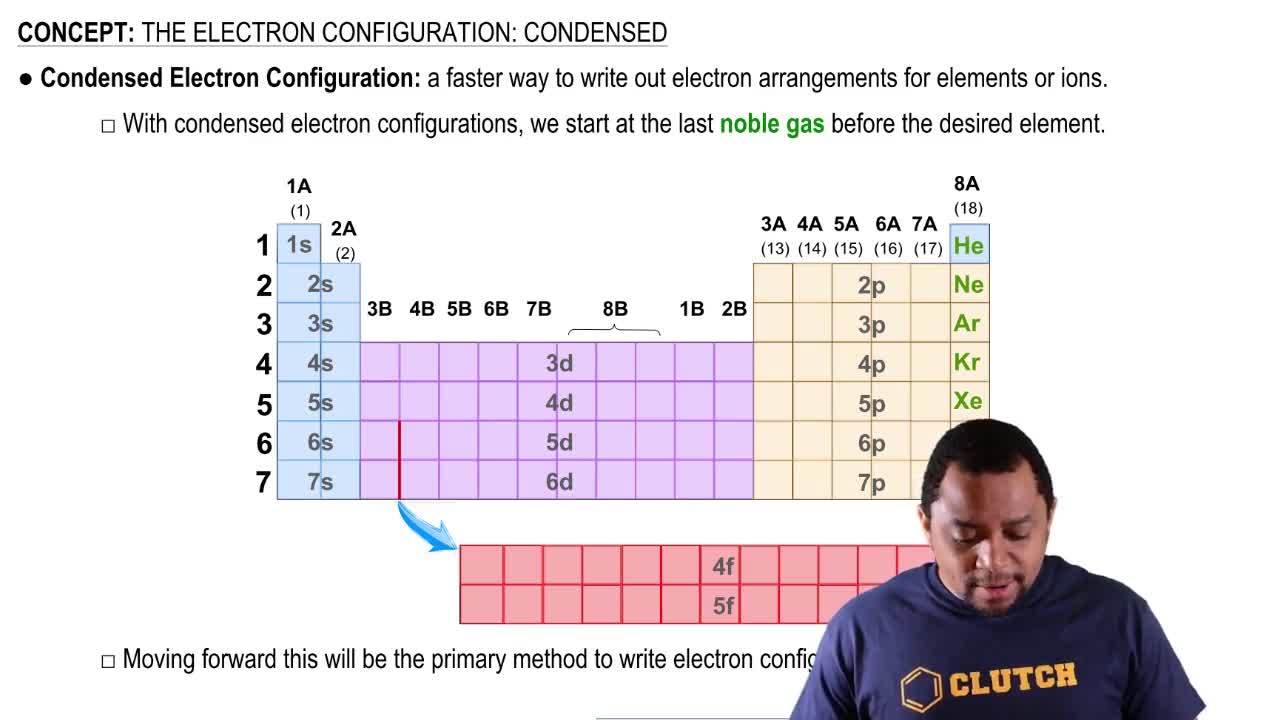
Write the electron configuration for neutral Co by filling the orbitals in order of increasing energy: 1s, 2s, 2p, 3s, 3p, 4s, 3d.
For Co, distribute the 27 electrons: 1s^2 2s^2 2p^6 3s^2 3p^6 4s^2 3d^7.
To find the electron configuration of Co^2+, remove 2 electrons from the highest energy level, which is the 4s orbital, resulting in: 1s^2 2s^2 2p^6 3s^2 3p^6 3d^7.
For Co^3+, remove an additional electron from the 3d orbital, resulting in: 1s^2 2s^2 2p^6 3s^2 3p^6 3d^6.
Verified video answer for a similar problem:
This video solution was recommended by our tutors as helpful for the problem above.
Video duration:
1m
Play a video:
0 Comments
Key Concepts
Here are the essential concepts you must grasp in order to answer the question correctly.
Electron Configuration
Electron configuration describes the distribution of electrons in an atom's orbitals. It follows the Aufbau principle, which states that electrons fill the lowest energy orbitals first, and is represented using a notation that indicates the energy levels and sublevels occupied by electrons. Understanding this concept is crucial for determining how many electrons are present in an atom and how they are arranged.
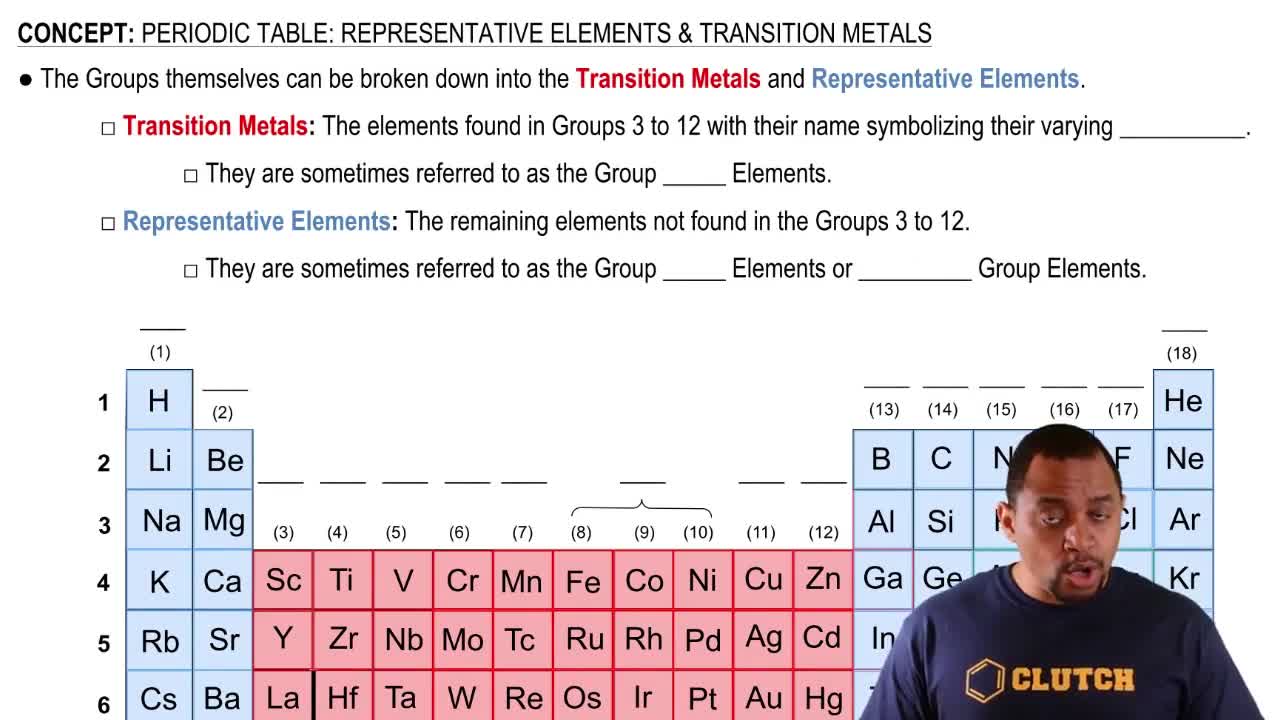
Transition metals, such as cobalt (Co), are elements found in the d-block of the periodic table. They are characterized by their ability to form variable oxidation states and complex ions due to the involvement of d electrons in bonding. This property is essential for understanding how cobalt can lose electrons to form Co^2+ and Co^3+ ions, affecting its electron configuration.
Periodic Table: Representative Elements & Transition Metals
Oxidation States
Oxidation states indicate the degree of oxidation of an atom in a compound, reflecting the number of electrons lost or gained. For cobalt, the oxidation states of +2 and +3 correspond to the loss of two and three electrons, respectively. This change in oxidation state alters the electron configuration, as fewer electrons will occupy the orbitals, which is key to writing the configurations for Co, Co^2+, and Co^3+.

 1:44 minutes
 Verified step by step guidance
 01:08
01:08