How can a nucleus emit an electron during β decay when there are no electrons present in the nucleus to begin with?
Verified step by step guidance
1
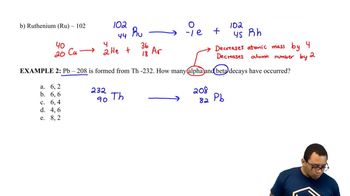
Understand that β decay involves the transformation of a neutron into a proton, an electron (β particle), and an antineutrino.
Recognize that the electron emitted during β decay is not an orbital electron but is created during the decay process itself.
Recall that a neutron is composed of quarks, and during β decay, a down quark is converted into an up quark, resulting in the emission of a W- boson.
The W- boson quickly decays into an electron and an antineutrino, which are then emitted from the nucleus.
Conclude that the electron emitted in β decay is a product of the decay process, not an electron that was originally present in the nucleus.
Was this helpful?
Key Concepts
Here are the essential concepts you must grasp in order to answer the question correctly.
Beta Decay
Beta decay is a type of radioactive decay in which an unstable atomic nucleus transforms into a more stable one by emitting a beta particle, which is an electron or a positron. In beta-minus decay, a neutron in the nucleus is converted into a proton, and an electron is emitted. This process helps to balance the ratio of neutrons to protons in the nucleus, leading to increased stability.
The weak nuclear force is one of the four fundamental forces of nature and is responsible for processes like beta decay. It governs the interactions that allow a neutron to change into a proton, facilitating the emission of an electron. This force operates at a very short range and is crucial for the stability of atomic nuclei, enabling transformations that alter the identity of elements.
Neutrons are subatomic particles composed of three quarks: two down quarks and one up quark. During beta decay, one of the down quarks in a neutron is transformed into an up quark, resulting in the neutron becoming a proton. This transformation is what allows the emission of an electron, as the process involves the conversion of quark types within the neutron.