Use the following orbital-filling diagram to show the electron configuration for As:
Verified step by step guidance
1
Identify the atomic number of arsenic (As), which is 33, indicating it has 33 electrons.
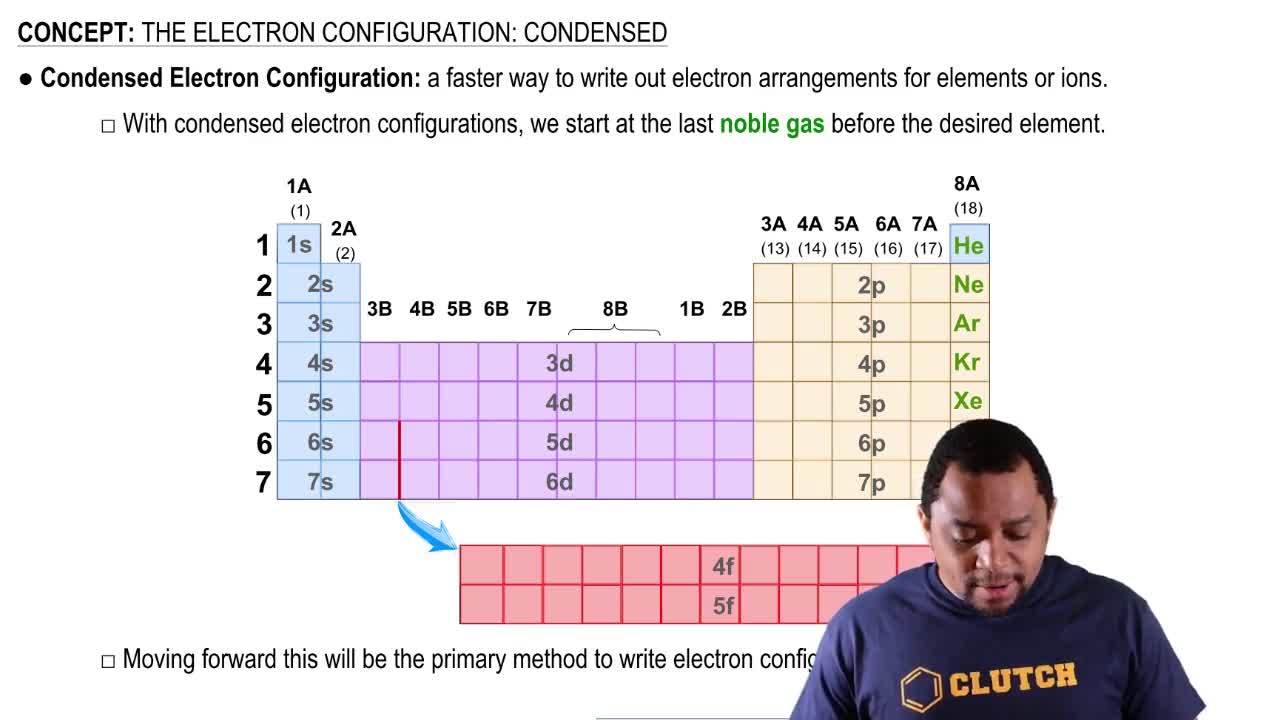
Use the Aufbau principle to fill the orbitals in order of increasing energy: start with the 1s orbital, then 2s, 2p, 3s, 3p, 4s, 3d, and finally 4p.
Apply Hund's rule when filling the p and d orbitals: each orbital in a subshell gets one electron before any gets a second.
Write the electron configuration using the notation: 1s^2 2s^2 2p^6 3s^2 3p^6 4s^2 3d^10 4p^3.
Verify that the total number of electrons in the configuration equals 33, confirming the electron configuration is complete.
Verified video answer for a similar problem:
This video solution was recommended by our tutors as helpful for the problem above.
Video duration:
1m
Play a video:
0 Comments
Key Concepts
Here are the essential concepts you must grasp in order to answer the question correctly.
Electron Configuration
Electron configuration describes the distribution of electrons in an atom's orbitals. It is represented using a notation that indicates the energy levels and sublevels occupied by electrons, following the Aufbau principle, Pauli exclusion principle, and Hund's rule. For arsenic (As), which has 33 electrons, the configuration reflects how these electrons fill the available orbitals in a specific order.
An orbital filling diagram visually represents how electrons are distributed among the various atomic orbitals. It typically shows the order in which orbitals are filled based on their energy levels, helping to illustrate concepts like electron pairing and the maximum capacity of each orbital. Understanding this diagram is crucial for determining the correct electron configuration for elements like arsenic.
The periodic table organizes elements based on their atomic number and electron configurations, which influence their chemical properties. Elements in the same group often exhibit similar behaviors due to their valence electron arrangements. For arsenic, located in group 15, its electron configuration plays a significant role in its reactivity and bonding characteristics, making it essential to understand when analyzing its electron configuration.

 1:46 minutes
 Verified step by step guidance
 01:08
01:08